The Night Stalker — Richard Ramirez and the 1980s California Manhunt
A non-graphic, source-based look at The Night Stalker — Richard Ramirez and the 1980s California Manhunt, separating documented facts from allegations,…
How do you want this story?
The Night Stalker — Richard Ramirez and the 1980s California Manhunt
A non-graphic, source-based look at The Night Stalker — Richard Ramirez and the 1980s California Manhunt, separating documented facts from allegations,… The Night Stalker — Richard Ramirez and the 1980s California Manhunt The Night Stalker Richard Ramirez - L.A. California. That summer people slept with their windows open. It was 1984 in Los Angeles and the heat never broke after midnight. That muggy, oppressive heat of summer that gets into the walls of a house and stays there, that makes a closed window a form of punishment, that causes people to leave things open just enough to let the air that exists blow through the rooms where their families are sleeping. It looked safe enough."…
The Night Stalker — Richard Ramirez and the 1980s California Manhunt
The Night Stalker Richard Ramirez – L.A. California.
That summer people slept with their windows open.
It was 1984 in Los Angeles and the heat never broke after midnight. That muggy, oppressive heat of summer that gets into the walls of a house and stays there, that makes a closed window a form of punishment, that causes people to leave things open just enough to let the air that exists blow through the rooms where their families are sleeping.
It looked safe enough.” They knew the neighborhood. Their street. Their own house, their own locks on the doors, their own people sleeping down the hall.
They had no reason to think that an open window was an invitation to anything but a breeze.
Then Richard Ramirez came in through those windows.
Where did he come from?
Richard Ramirez did not just appear in Los Angeles. Bit by bit he was fashioned from a childhood that gave him almost nothing worth holding onto, and stole from him almost everything worth having.
He was raised in a poor home in El Paso, Texas, where stability was never a sure thing. But the most lasting damage would be done by his older cousin, a veteran who had returned from Vietnam carrying the things that wars leave in people when they are finished with you.
Things that shouldn’t be shared with a child. This cousin filled the young Ramirez’s head with images and ideas no boy should ever see, and something in Ramirez soaked it up and never let it go.
By his teens he was already heading down the wrong road – drugs, petty crime, the path of a young man with no moorings and no one to pull him back to anything resembling a normal life. He ended up drifting to Los Angeles, as people do when they have nowhere else specific to go, and settled into the cheap hotels of downtown, surviving by stealing, disappearing into the margins of a city large enough to make a person invisible if they want to be.
Nobody was looking at Richard Ramirez. Not yet.
What He Did (2)
The attacks began in 1984 and carried into 1985, spreading a kind of fear across Southern California that the region had never seen before and never forgotten.
He went through suburbs that never thought of themselves as dangerous: Monterey Park, Mission Hills, Burbank, communities throughout the Los Angeles area. He came through unbarred doors. He entered by open windows. He came at night, when the families were sleeping, the houses were silent, and no one anticipated anything happening.
He killed fourteen people. He also beat and abused many others. And what made the fear so absolute, what set this case apart from other crimes the city had absorbed and moved on from, was its sheer randomness. Young and old, his victims were. Women and men. Different neighborhoods, different backgrounds, no pattern anyone could see and use to feel safe by exclusion.
There was no profile that excluded you from the circle of danger. There was no neighborhood you could live in, no age you could be, no precaution so obvious that you were not next. Deadbolts sold out at hardware stores. Gun sales skyrocketed overnight. Every morning, neighbors across the city called each other to check that everyone on the street was still alive.
They called him The Night Stalker.
The name spread from Los Angeles to the rest of the country, and with it spread the fear — the specific, shapeless fear of a threat that does not follow rules and does not have a face yet and could be anywhere.
How It All Came Out
One fingerprint led to the break in the case.
They lifted it from a stolen car in downtown Chinatown, Los Angeles, and ran it through California’s new computerized fingerprint database — which was so new in 1985 that its use in this case was one of the first times it had been used in a major criminal investigation. The database spat out a name.
Richard Ramírez.
August 30, 1985, his picture was on the front page of every newspaper in town. The next morning Ramirez walked into a convenience store in East Los Angeles and saw his own face staring back at him from every newspaper rack in the place. He ran
What followed was not the job of the police or detectives. It was the work of the community he had terrorized for a year. As he ran, neighbors recognized him. They chased him through yards and alleys, block after block, and when they caught him they held him down on the ground until the police came.
The man who had slipped through Los Angeles like a shadow for more than a year, who had entered homes in the dark and left devastation in his wake, was stopped not by some sophisticated police operation but by ordinary people on an ordinary street who recognized his face and refused to let him go.
In 1989 he was tried and convicted of 13 murders and sentenced to death. Wikipedia’s Richard Ramirez page says that he spent the next several decades on death row at San Quentin State Prison, becoming one of the most infamous criminals in the history of American court cases, before dying of cancer in 2013. The state never got the chance to carry out his sentence. The disease got there first.
What is Left Behind
Fourteen didn’t survive that summer.
They went to sleep in their own beds, in their own homes, in neighborhoods where they had every right to feel secure, and they never woke up again. They were not characters in a narrative.
They were not episodes of a true crime series or entries on a documentary timeline. They were people, with families and histories and ordinary lives, just ended, without warning and without any chance of appeal, by a man who came through an open window in the night.
Their names should be remembered apart from his. More room than the story of the person who took them deserves their lives. There were fourteen funerals in Los Angeles in 1984 and 1985 and the grief for each of them was real and particular and it did not diminish because the case eventually became famous.
The Night Stalker was not a story anyone who lived through it found compelling or interesting. It was a year of real, sustained terror–families sleeping in houses with every window locked in summer heat; neighbors calling each other every morning to confirm the obvious; a city that had lost its sense of safety so completely that it took years to get it back.
All cities do.
Los Angeles recovered. The windows opened once more. The fear became memory and then history.
But that summer fourteen people didn’t come back.
And that’s the main thing, in this story.
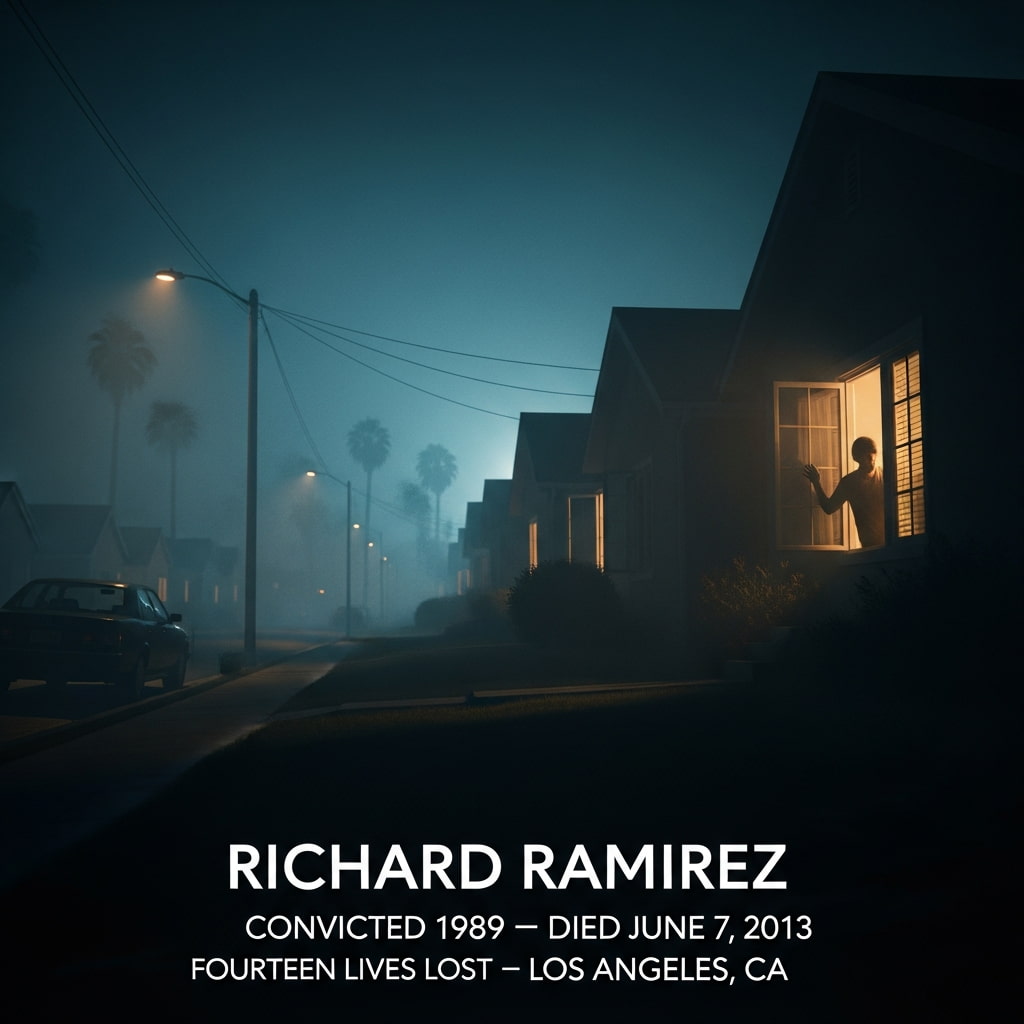
Richard Ramirez · The Night Stalker · Los Angeles, CA
Active 1984-1985 Convicted 1989 Died June 7, 2013
14 lives lost · Not forgotten.
If you want to read more like this, click here: Barker–Karpis Gang — Bank Robberies, Kidnappings and the FBI
The Night Stalker The Night Stalker The Night Stalker The Night Stalker The Night Stalker
Sources & References
- California Attorney General archive — Night Stalker / Richard Ramirez case reference: https://oag.ca.gov/sites/all/files/agweb/pdfs/victimservices/CAllenPressPackE2.pdf
- Los Angeles Times archive and court reporting are useful secondary sources for the Ramirez trial.
- California Attorney General archive — Night Stalker / Richard Ramirez case reference ↗
- Los Angeles Times archive and court reporting are useful secondary sources for the Ramirez trial.
TaleHive separates published reporting from personal accounts and editorial context where relevant.
More from the hive
Richard McCoy and the 1972 United Airlines Skyjacking
Gilgo Beach Serial Killings — The Case That Changed in 2026