The Headless Horseman — Sleepy Hollow, New York
Explore the folklore, history and reported traditions behind The Headless Horseman — Sleepy Hollow, New York. Supernatural claims are presented as legend,…
How do you want this story?
The Headless Horseman — Sleepy Hollow, New York
Explore the folklore, history and reported traditions behind The Headless Horseman — Sleepy Hollow, New York. Supernatural claims are presented as legend,… The Headless Horseman, Sleepy Hollow, New York There are places in America where the past will not stay buried. Not in a metaphorical way. Not in the way that historians mean when they talk about the legacy of past events shaping the present. More literally, more disturbingly, where the weight of what happened in a particular place seems to push up through the ground itself, through the stones and the soil and the quiet of an autumn evening, in ways that are difficult to explain and impossible to fully dismiss. One of those…
The Headless Horseman, Sleepy Hollow, New York
There are places in America where the past will not stay buried.
Not in a metaphorical way. Not in the way that historians mean when they talk about the legacy of past events shaping the present. More literally, more disturbingly, where the weight of what happened in a particular place seems to push up through the ground itself, through the stones and the soil and the quiet of an autumn evening, in ways that are difficult to explain and impossible to fully dismiss.
One of those places is Sleepy Hollow, N.Y.
It sits in a valley on the east bank of the Hudson River some thirty miles north of New York City, tucked into Westchester County, which has borne a dark reputation for more than two centuries. It’s old Dutch settlement country—a landscape of old stone churches, low fieldstone walls, and family names carved into headstones from the 1600s.
This is not a history that can be summarized quickly and passed along. It’s the kind that sinks into the earth and remains. Hefty. Permanent. Not wanting to let go of the living.
If you grew up in the valley you’ll tell me there’s always been something strange about it. Something in the quality of silence some evenings. Something in the way the autumn mist rises from the Hudson and curls through the trees that line the old roads, making familiar paths stranger and less sure.
It makes the valley feel as if the space between the present moment and a very old past is thinner than it has any right to be, even in the day.
And then it goes dark. The roads are empty. The trees crowd in on the old stone bridges.
And the rider’s story starts again.
The Legend Before the Tale
For most people Washington Irving is the introduction to Sleepy Hollow. His 1820 story, The Legend of Sleepy Hollow, gave us Ichabod Crane, a tall, superstitious schoolteacher who rides home through the valley one dark autumn night, and meets something he does not come back from.
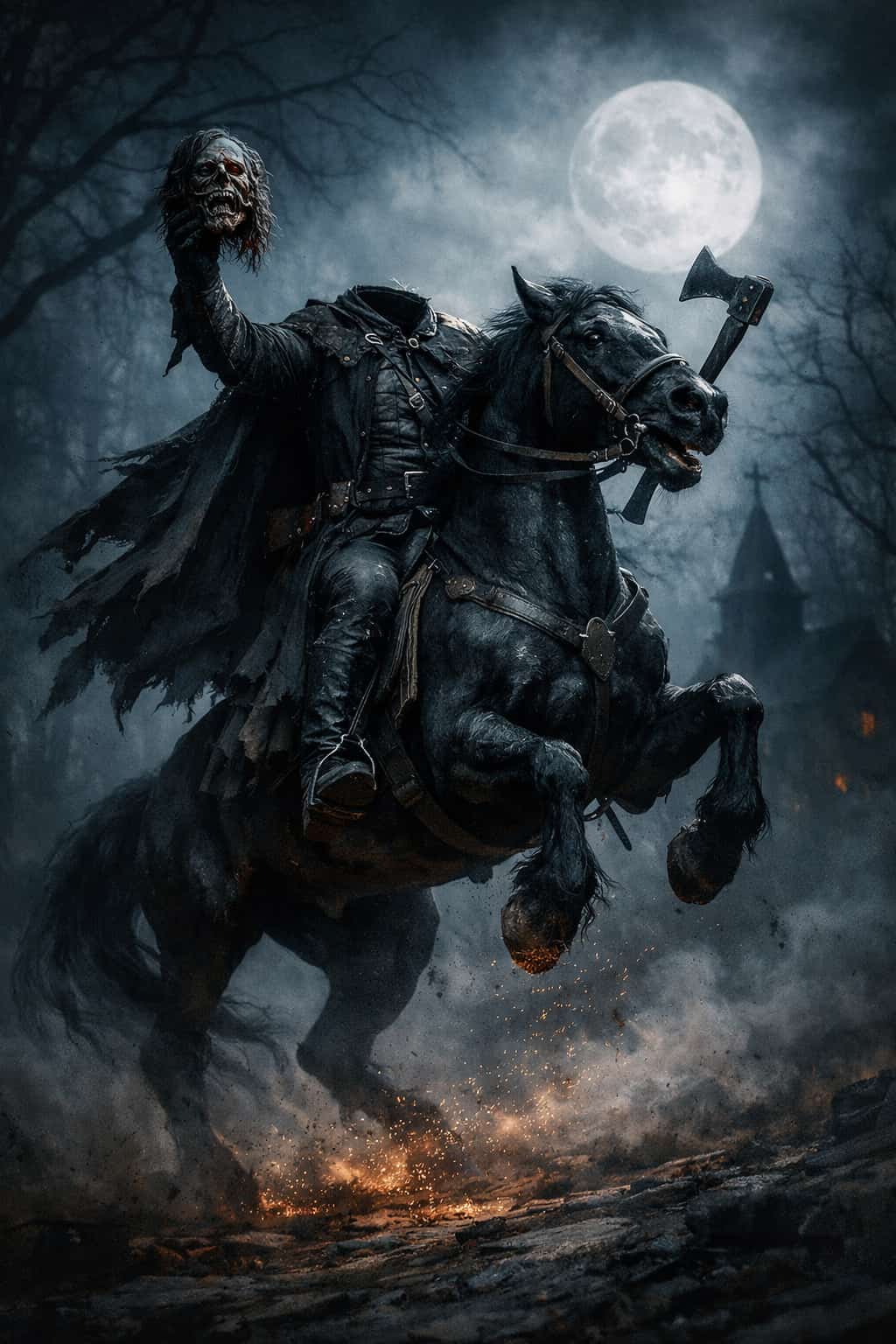
A great figure on a black horse going fast through the shadows of the tree line, bearing tucked under one arm the thing that ought to have been resting on his shoulders.
His head taken off.
Never seen again after that night, Ichabod was. It is left deliberately ambiguous whether the schoolteacher was possessed by something genuinely supernatural or just scared badly enough to leave the valley forever and never look back. That ambiguity is why the story has survived for two centuries – the refusal to give a clean explanation that resolves everything neatly and lets the reader breathe again.
Irving did not create the Headless Horseman, however. He lent him.
Long before Irving picked up a pen, the folklore of the Hudson Valley was already dark and layered. Stories of a headless rider haunting the roads of Sleepy Hollow were circulating among local residents before they appeared in print.
Through centuries of hushed stories and strange sights, through the atmosphere of a place that seemed to breed fear naturally, the valley had made something. Irving took it and made it into something the world could read. But the original terror was the people who really lived in that valley and rode those roads at night.
Who Was the Rider
The earlier versions of the story, before Irving formalized them, give different reasons for who the horseman was and why he could not rest.
The most common story is that he was a Hessian soldier, a German mercenary who fought for the British in the American Revolutionary War and lost his head to a cannonball during one of the battles that ravaged the Hudson Valley in the 1770s. His body, the story goes, lies somewhere in the valley, in unconsecrated ground, and his spirit has never rested easy.
Every night he rides out from his grave looking for his missing head. Anyone unlucky enough to cross his path on the wrong evening becomes part of the story in ways they didn’t expect.
Other versions are more vague about the origins and more concerned with atmosphere. They talked of the valley itself as a place that had always been strange, a hollow where the air felt different,
where dreams came heavy and dark, where the spirits of the dead seemed closer to the surface than in other parts of the country. So the horseman is merely the most obvious expression of something born of the land from time immemorial.
Whatever the actual source, the image was forever etched in the minds of all who heard it. A headless horseman. A black stallion. Between dark trees on an autumn night a narrow road.
It’s one of the most enduring images to emerge from American folklore.
The Valley’s Atmosphere
There is something about Sleepy Hollow that the stories have always tried and never quite managed to pin down.
Here the nights are very still. Not quiet, more like held-breath-still, the kind of silence that waits, not just rests.
The winds in the old trees along the Hudson move in ways that on certain evenings sound remarkably like whispered voices just below the threshold of understanding. Stone bridges cross the creeks running through the valley, and they cast long shadows in moonlight; shadows that move in ways that do not always correspond to what is casting them.
It’s the kind of thing locals who’ve lived here their entire lives talk about as if it’s nothing, the way people discuss some strange fact that’s been around so long it no longer seems strange, it’s just part of the texture of this place.
Some autumn evenings the echo of hoofbeats has been heard through the valley with no horse in sight. A beat on the old roads, steady and quick, growing louder then stopping for no reason at all.
The fear was never simply in the story. It was in the land itself, and the story grew out of it like everything else in the valley grew, slowly, deeply rooted, impossible to fully uproot.
What Sleepy Hollow Looks Like Today
Two hundred years after Washington Irving wrote his story, Sleepy Hollow remains. The old Dutch church is still there. Beside it is the cemetery, one of the oldest in New York, which still contains the graves of families whose names have been in this valley since before the country was born. The Hudson still runs past the east side of town, gray and broad and uncaring.
And every fall the valley fills again.
People come from all over the country and from overseas, walk the same roads that Ichabod Crane walked in the story, stand on the old bridge where the encounter is supposed to have occurred, gaze out at the tree line as the light fades and the air gets cold and the character of the place begins to assert itself in the way it always has.
The legend has inspired novels, films, television series, and countless retellings during two centuries of American popular culture. According to Wikipedia’s entry on The Legend of Sleepy Hollow, Irving’s original story remains one of the earliest and most lasting instances of American literary fiction — a story so tied to a particular place that the place and the story have become one and the same.
But underneath all of that—the tourism, the Halloween festivals, the adaptations, the merchandise—the original story is still there. The same story told in whispers by Dutch settlers in a hollow of the Hudson Valley more than two hundred years ago, before it was written, before it was famous.
A rider without a head. A black horse. A road between dark trees on an autumn night
Some stories, once they find a place, do not depart.
In Sleepy Hollow, it always had been.
Sleepy Hollow ( 1999 ) · Westchester County, NY · Founded 1600s · The Headless Horseman / · Still haunting the valley today.
If you want to read more like this, click here: White Lady —Various locations across America
Sources & References
- Washington Irving, The Legend of Sleepy Hollow (public-domain literary work)
- Library of Congress — historic Sleepy Hollow material: https://www.loc.gov/
- Washington Irving, The Legend of Sleepy Hollow (public-domain literary work)
- Library of Congress — historic Sleepy Hollow material ↗
TaleHive separates published reporting from personal accounts and editorial context where relevant.
More from the hive
 🎧 Audio Available
The School the World Forgot
Villisca Axe Murders – 1912