Barker–Karpis Gang — Bank Robberies, Kidnappings and the FBI
A non-graphic, source-based look at Barker–Karpis Gang — Bank Robberies, Kidnappings and the FBI, separating documented facts from allegations,…
How do you want this story?
Barker–Karpis Gang — Bank Robberies, Kidnappings and the FBI
A non-graphic, source-based look at Barker–Karpis Gang — Bank Robberies, Kidnappings and the FBI, separating documented facts from allegations,… Barker–Karpis Gang — Bank Robberies, Kidnappings and the FBI They were not the brightest. No legends were they. They were just people who had nothing when they were young, made the worst choices, and ran until they could not run anymore. History names them The Barker Karpis mob. The FBI called them the most dangerous gang in the US. They were, the truth is, mostly desperate people in a desperate era. Ma Barker was a Missouri mother who loved her four sons with a blind, stubborn love that asked no questions and made no demands. Her…
Barker–Karpis Gang — Bank Robberies, Kidnappings and the FBI
They were not the brightest. No legends were they. They were just people who had nothing when they were young, made the worst choices, and ran until they could not run anymore.
History names them The Barker Karpis mob. The FBI called them the most dangerous gang in the US. They were, the truth is, mostly desperate people in a desperate era.
Ma Barker was a Missouri mother who loved her four sons with a blind, stubborn love that asked no questions and made no demands. Her boys – Herman, Lloyd, Arthur and Fred – were born poor and restless and they fell into trouble as naturally and with as little resistance as water runs downhill. And Ma never drove them to crime. She never pushed them away from it, either. She followed where they led, cooked their meals, paid their rent, and kept her eyes closed to everything happening around her.
She adored them. That was her greatest strength and her greatest weakness.
Alvin Karpis was the brains behind the actual crimes, a cool, calculating man who had been pick-locking and store-robbing since he was a teenager in Kansas. He was not loud and reckless like some of the criminals of that time. He was quiet, disciplined and had a touch that was dangerously good. Fred Barker and he were a focused, efficient team, and together they constructed something that terrorized the American Midwest for five straight years.
First they robbed banks, sweeping across Minnesota and the surrounding states, hitting hard and leaving fast. In December 1932 they walked into the Third Northwestern Bank in Minneapolis and left with cash and two dead cops on the pavement behind them. That made the difference. The FBI, a still-new agency trying to establish its reputation, zeroed in on the gang and never let go.
So the gang switched tactics and went into kidnapping, where the money was bigger and, they felt, the risk more manageable.
They kidnapped William Hamm Jr., the well-known, rich owner of Hamm’s Brewing Company, right off the sidewalk in St. Paul, Minnesota, on a warm June morning in 1933, in broad daylight as he walked from his brewery to his home. They took him to a safe house in Bensenville, Illinois, blindfolded and kept him quiet for four days, and sent a ransom note to his family. The family paid $100,000 without batting an eye. Hamm returned home, shaken, pale, and alive.
Encouraged they did it once more. In January 1934 they kidnapped Edward Bremer, a well-respected St. Paul banker with White House connections, pulling him out of his own car on South Lexington Parkway on a cold morning as he dropped his young daughter off at school. Bremer was held for twenty-one days, transferred from dark room to dark room in various safe houses, never knowing where he was or if he was going home. His family paid $200,000 to recover him. They brought him back thin and worn, dumped on a roadside just outside Rochester, Minnesota, blinking in the daylight like a man who forgot what it looked like.
Two abductions. Weeks that separated two families. Ransom: $300,000. And not a single arrest for a time.
But the money had a trail. The ransom bills were marked and as they started popping up at shops and banks all across the Midwest, federal agents followed each one like a breadcrumb. There were safe houses. Friends and associates gathered quietly and started talking. Slowly the circle around the gang tightened, like a net tightening, until there was almost nowhere left to move.
Fred and Ma Barker had made it all the way to Ocklawaha, Florida, a quiet little lakeside town in the middle of the state, where they had been renting a cottage on the edge of Lake Weir for several months, living under false names, keeping to themselves, trying to look like ordinary people on an extended vacation.
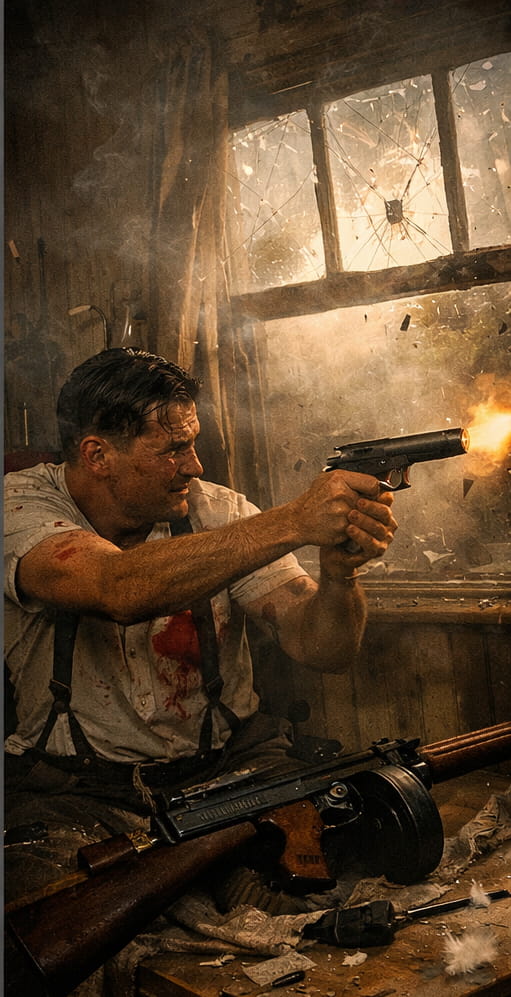
On the morning of January 16, 1935, FBI agents surrounded that same cottage from every direction. What followed was almost four hours of gunfire, long enough for neighbors along the lake to realize what was happening and find themselves in a place of safety. The sound rolled out across the still water of Lake Weir, and carried for miles.
When the shooting ended, both Fred Barker and Ma Barker were dead in the cottage. Fred had been hit several times. Ma’s body was small and still in the quiet of the room near a machine gun. She was sixty-one years old. She would followed her boys to the end of the road. The road had ended here, in a rented cottage by a Florida lake, far from the Missouri hills where she would been born.
Alvin Karpis was the last to go. He spent the next year going from city to city, living on gut and old contacts, always a step ahead of the agents on his tail. He was placed on the FBI’s first ever Most Wanted list, and J. Edgar Hoover made capturing him a matter of personal pride.
Finally, on the afternoon of May 1, 1936, agents caught up with him on Canal Street in New Orleans, one of the busiest streets in the city, where he was strolling calmly to his car. They were on him before he could react. Hoover himself flew to New Orleans to witness the arrest, wanting to be the one to slap the cuffs on personally.
Nobody had remembered to bring the handcuffs. They bound Karpis’s wrists with an agent’s necktie.
He would spend the next twenty six years on Alcatraz Island, the longest stretch of any inmate in the history of that prison. He was released in 1969, deported back to Canada, and died quietly in Spain in 1979. In his later years he wrote a memoir. He wasted no time in apologizing.
When the story is over, it is not the crimes or the chases or the courtrooms that stay with you. It’s the small, more human things underneath all of it.
A mother following her sons to a place she should never have gone. A man who was such a good runner it took the FBI 5 years to catch him. Two kidnapped victims sitting blindfolded in dark rooms, not knowing if they would ever see their families again. One December morning in Minneapolis, two police officers went to work and never came back home.
Barker Karpis
In the popular imagination, The Depression romanticized the outlaw. Times were so hard on people that they cheered for anyone who seemed to be fighting back against something, even if the fighting was cruel and the victims were ordinary and innocent.
The romance was always a sham. The damage was always genuine.
But the people were real, too, on every side of it. That is the part that gets lost in the legend, and the part of most worth remembering.
Ma and Fred Barker —Murdered Jan. 16, 1935 · Ocklawaha, Fla.
Alvin Karpis · Apprehended May 1, 1936 · New Orleans, Louisiana
Five years. Over a dozen states. End of story.
If you want to read more like this, click here: Alcatraz escape
Barker Karpis Barker Karpis Barker Karpis Barker Karpis Barker Karpis Barker Karpis Barker KarpisSources & References
- FBI — Barker/Karpis Gang: https://www.fbi.gov/history/cases-and-criminals/barker-karpis-gang
TaleHive separates published reporting from personal accounts and editorial context where relevant.
More from the hive
Richard McCoy and the 1972 United Airlines Skyjacking
Gilgo Beach Serial Killings — The Case That Changed in 2026