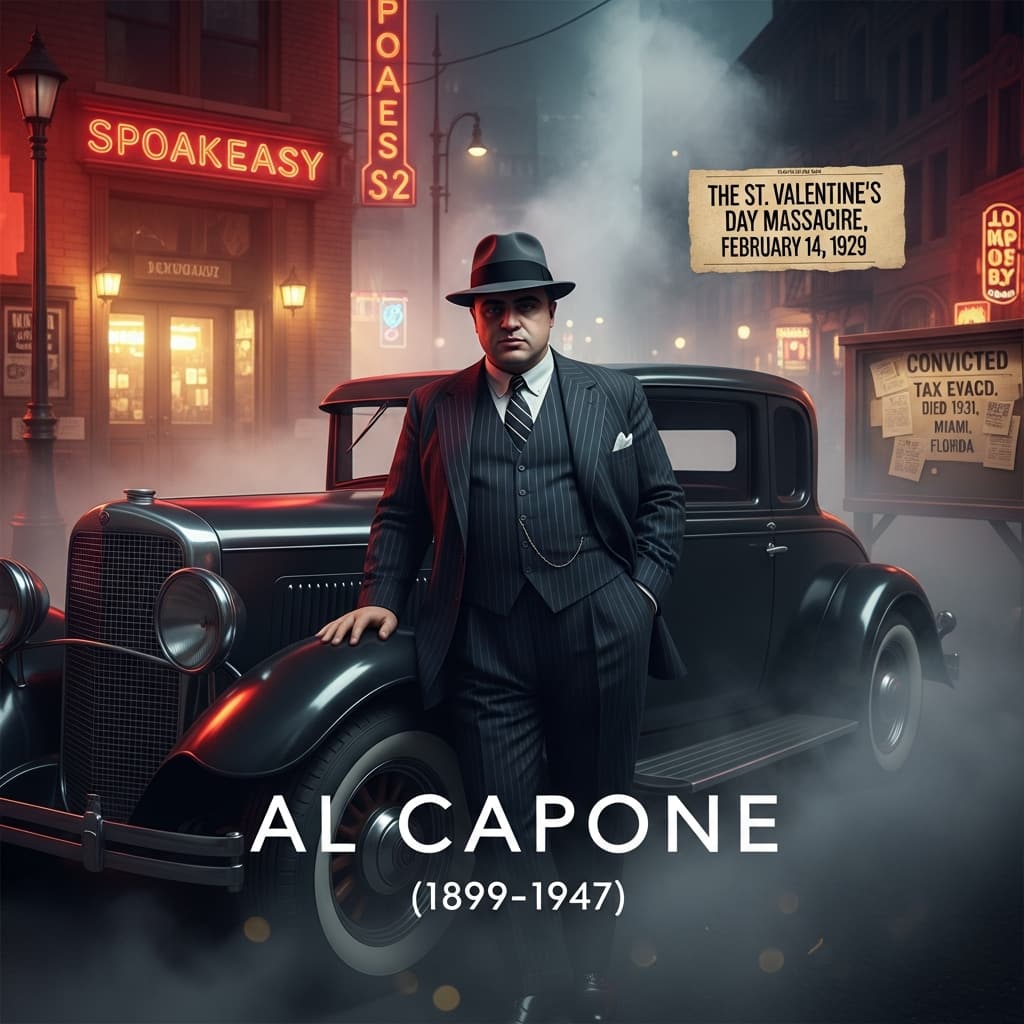
AL Capone
A non-graphic, source-based look at AL Capone, separating documented facts from allegations, uncertainty and later interpretation.
How do you want this story?
AL Capone
A non-graphic, source-based look at AL Capone, separating documented facts from allegations, uncertainty and later interpretation. Al Capone – 1920s Chicago. The Rise and Fall of America’s Most Dangerous Gangster Some people are the product of their time. ProhibitionProhibition, poverty, a city willing to be bought, and an era in American history that created a vacuum of power so large that someone was always going to fill it, made Al Capone. He just did it better than the others. And he made everybody know it. The Brooklyn Boy Alphonse Gabriel Capone was born in Brooklyn, New York, on January 17, 1899, to Italian immigrants who came to America in search of what every immigrant has…
Al Capone – 1920s Chicago.
The Rise and Fall of America’s Most Dangerous Gangster
Some people are the product of their time.
ProhibitionProhibition, poverty, a city willing to be bought, and an era in American history that created a vacuum of power so large that someone was always going to fill it, made Al Capone.
He just did it better than the others.
And he made everybody know it.
The Brooklyn Boy
Alphonse Gabriel Capone was born in Brooklyn, New York, on January 17, 1899, to Italian immigrants who came to America in search of what every immigrant has always searched for — something better than what they left behind.
His father, Gabriele, was a barber. His mother, Teresa, was a seamstress. They were honest, hardworking people who moved into the Garfield Place neighborhood of Brooklyn and tried to make a decent living with what they had.
But the neighborhood had its own set of rules. Its own rank order Its own economy – a parallel economy to the official one, and for many of the young men growing up in it, a much more accessible one.
Al Capone wasn’t a dumb boy. He was charming, quick-witted, socially gifted in the way that some people are — the kind of person who could read a room instantly and make everyone in it feel he was exactly who they needed him to be, by most accounts. He also did not think that the quickest way out of poverty was to obey the rules.
He was fourteen years old and left school after hitting a teacher. He fell in with street gangs, first the Junior Forty Thieves, then the Brooklyn Rippers, then finally into the orbit of Johnny Torrio and Frankie Yale, two men building something a good deal more organized, a good deal more profitable than street-level crime.
Al Capone got his most valuable education not inside the classroom, but on the streets of Brooklyn.
Chicago,
In the early 1920s, Johnny Torrio moved his operations to Chicago — and took the young Capone with him.
Chicago was a city that overnight became transformed by a single piece of legislation in the early 1920s. The 18th Amendment to the U.S. Constitution, ratified in 1920, prohibited the manufacture and sale of alcohol anywhere in the United States. Its supporters believed that Prohibition would cleanse American society of crime, strengthen families, improve public health.
It did exactly that.
Prohibition actually created the largest and most profitable illegal market in American history. There were millions of Americans who craved booze. They would always wanted it. Making it illegal did not stop them wanting it, it just meant the people supplying it were now criminals and the profits that had previously gone to legitimate businesses now went to organised crime.
That market was always going to be filled by somebody.
In Chicago, that somebody was Al Capone.
Torrio retired and left Chicago after a near fatal shooting in 1925, and the entire operation was taken over by Al Capone, who was twenty-six years old. He had inherited a network of breweries, speakeasies, gambling dens and brothels that sprawled across the city and built it into something that made an estimated sixty million dollars a year.
Sixty million dollars. In the 1920s
He was twenty-six years old. He ran Chicago.
The Celebrity Gangsta
It wasn’t the scope of his operation, impressive though that was, that set Al Capone apart from the other criminals of his era. It was the audacity of it.
He did not hide himself.
Other gangsters understood the importance of invisibility—that is, staying out of the newspapers, keeping their names out of conversations, keeping the fiction that they were legitimate businessmen while doing everything possible to make sure that nobody looked too closely.
Al Capone dismissed all that out of hand.
He gave interviews to the newspapers. He would sit ringside at big boxing matches in expensive suits covered with diamond jewelry, waving to the crowd like a politician at a rally. He was always photographed. Everyone recognised him wherever he went and he seemed to really like it – the attention, the notoriety, the celebrity.
In a very real sense, he was the first celebrity gangster. The archetype for all fictional mob bosses.
Chicago knew who he was and what he did. His own politicians knew. The judges he purchased knew. The cops he had working for him knew it. And for years nobody did anything about it. Mostly. Because doing something about it meant taking on a man who had sixty million dollars a year and was not shy about how he spent it.
St. Valentine’s Day Massacre
By the late 1920s, Capone’s main rival in Chicago was the North Side Gang, led by George “Bugs” Moran. The two groups had been locked in a bloody, grueling war for years, assassinations, ambushes, reprisals in a never ending cycle that left bodies strewn all over the city.
Capone decided to finish it.
On the morning of February 14, 1929—Valentine’s Day—gunmen dressed as police officers entered a garage at 2122 North Clark Street on Chicago’s North Side. Seven of Moran’s thugs were backed against a brick wall and shot dead.
The St. Valentine’s Day Massacre was a shock even to a city that had grown accustomed to gangland violence. The killing of seven men in a garage on Valentine’s Day could not be dismissed or rationalized.
Al Capone was in Miami at the time. He was never indicted.
But the slaughter was a watershed. The federal government, which had been after Capone for years without finding a way to get at him, now zeroed in. There was something to do.
The Fall The man who took down Al Capone never fired a gun.
His name was Eliot Ness, a federal agent who commanded a team of investigators—subsequently dubbed “The Untouchables” because they refused to accept bribes—who systematically raided Capone’s breweries and documented his illegal activities in excruciating detail.
But it was not Ness who finally put Capone behind bars.
It was the IRS.
Capone had been raking in tens of millions of dollars in illegal income for years and not paying a penny of tax on any of it. Federal investigators quietly and painstakingly built a financial case against him. They traced money, documented transactions, built a picture of income Capone had never declared.
Al Capone was charged in 1931 with twenty-two counts of federal tax evasion.
He would be in court every day, looking sharp and confident, knowing he could talk or pay his way out of the charges, just like he would done with every other threat to his operation. He had, it was said, already bribed enough jurors to assure his acquittal.
The judge listened. He changed the entire jury panel at the last moment.
Capone was found guilty. He was sentenced to eleven years in federal prison and a stiff fine. He ended up as inmate number 85 on Alcatraz Island in San Francisco Bay, the prison where Alvin Karpis would later be serving his record-breaking sentence.
There was no celebrity treatment on Alcatraz. Only the expensive suits. No seats on ringside. No politicians bought, no judges cooperative. Nothing but a prison cell and work details—laundry duty—and the slow, ruinous course of untreated syphilis that had been eating at his brain and body for years.
The end.
1939 – Al Capone released from prison.
He was forty. He walked and looked as if he were much older. Syphilis had claimed his mind and body; the clever, charismatic, socially brilliant man who had dominated Chicago was gone, replaced by someone befuddled and diminished.
He retreated to his Palm Island estate in Miami, living quietly and largely removed from the world he once ruled.
Al Capone died of cardiac arrest on January 25, 1947 at age forty-eight.
For a city he had owned for a decade, it barely knew.
The Legacy Al Capone killed people. He destroyed a whole city. He bought politicians and judges and police officers. And poisoned the institutions that were supposed to protect ordinary citizens. The damage he did was real and permanent, and it shouldn’t be glorified.
But he was also a man of his times — of poverty, of Prohibition, of an America that created the conditions that made him possible, and exploited them.
He was caught, in the end, not for the murders, or the corruption, or the decades of organized crime. He was arrested for taxes.
To this day the murders are unsolved.
That is the way it is.
Al Capone · Birth January 17, 1899 · Brooklyn, New York
Ran Chicago 1925-1931 · $60 million per year in today’s dollars
St. Valentine’s Day Massacre · February 14, 1929
Convicted of tax evasion 1931 · Died January 25, 1947 · Age 48 years.
If you want to read more like this, click here: The Night Stalker — Richard Ramirez and the 1980s California Manhunt
Sources & References
- FBI — Al Capone: https://www.fbi.gov/history/cases-and-criminals/al-capone
TaleHive separates published reporting from personal accounts and editorial context where relevant.
More from the hive
Richard McCoy and the 1972 United Airlines Skyjacking
Gilgo Beach Serial Killings — The Case That Changed in 2026