The New Orleans Axeman — 1918–1919
A non-graphic, source-based look at The New Orleans Axeman — 1918–1919, separating documented facts from allegations, uncertainty and later interpretation.
How do you want this story?
The New Orleans Axeman — 1918–1919
A non-graphic, source-based look at The New Orleans Axeman — 1918–1919, separating documented facts from allegations, uncertainty and later interpretation. The New Orleans Axeman — 1918–1919 The Shocking Story of a Killer Who Terrorized a City and Was Never Caught Some cities have a heartbeat you can hear from the street. New Orleans is one of them. Jazz pours from open doorways at all hours. The air smells of coffee and rain on old stone. Neighbors know each other by name, share food across fences, keep each other's secrets the way people do in cities that have been through enough together to understand what community actually means. But in the spring of 1918, something crept…
The New Orleans Axeman — 1918–1919
The Shocking Story of a Killer Who Terrorized a City and Was Never Caught
Some cities have a heartbeat you can hear from the street.
New Orleans is one of them.
Jazz pours from open doorways at all hours. The air smells of coffee and rain on old stone. Neighbors know each other by name, share food across fences, keep each other’s secrets the way people do in cities that have been through enough together to understand what community actually means.
But in the spring of 1918, something crept into that warmth.
Something that came after midnight, when the music had stopped and the streets had gone quiet, and left no witnesses behind.
The City Before the Fear
To understand what the Axeman did to New Orleans, you have to understand what New Orleans was before he arrived.
It was a city of immigrants — particularly Italian immigrants, who had come to Louisiana in large numbers in the late 19th and early 20th centuries, building lives as grocers, tradesmen, and small business owners in tight-knit neighborhoods where everyone looked out for everyone else.
These were not wealthy people. They were working people — people who had crossed an ocean for the chance at a better life, who had built something modest and real in a new country, and who went to bed each night in the reasonable expectation that they would wake up in the morning.
The Axeman took that expectation away from all of them.
The First Night
It was May 1918 when New Orleans first learned his name — though name is too dignified a word for what he was.
Joseph Maggio was an Italian grocer. He and his wife Catherine lived above their small grocery store in the kind of modest, decent arrangement that thousands of immigrant families had built across the city. They went to bed on the night of May 22nd the way they always did.
A neighbor found them in the early hours of the morning.
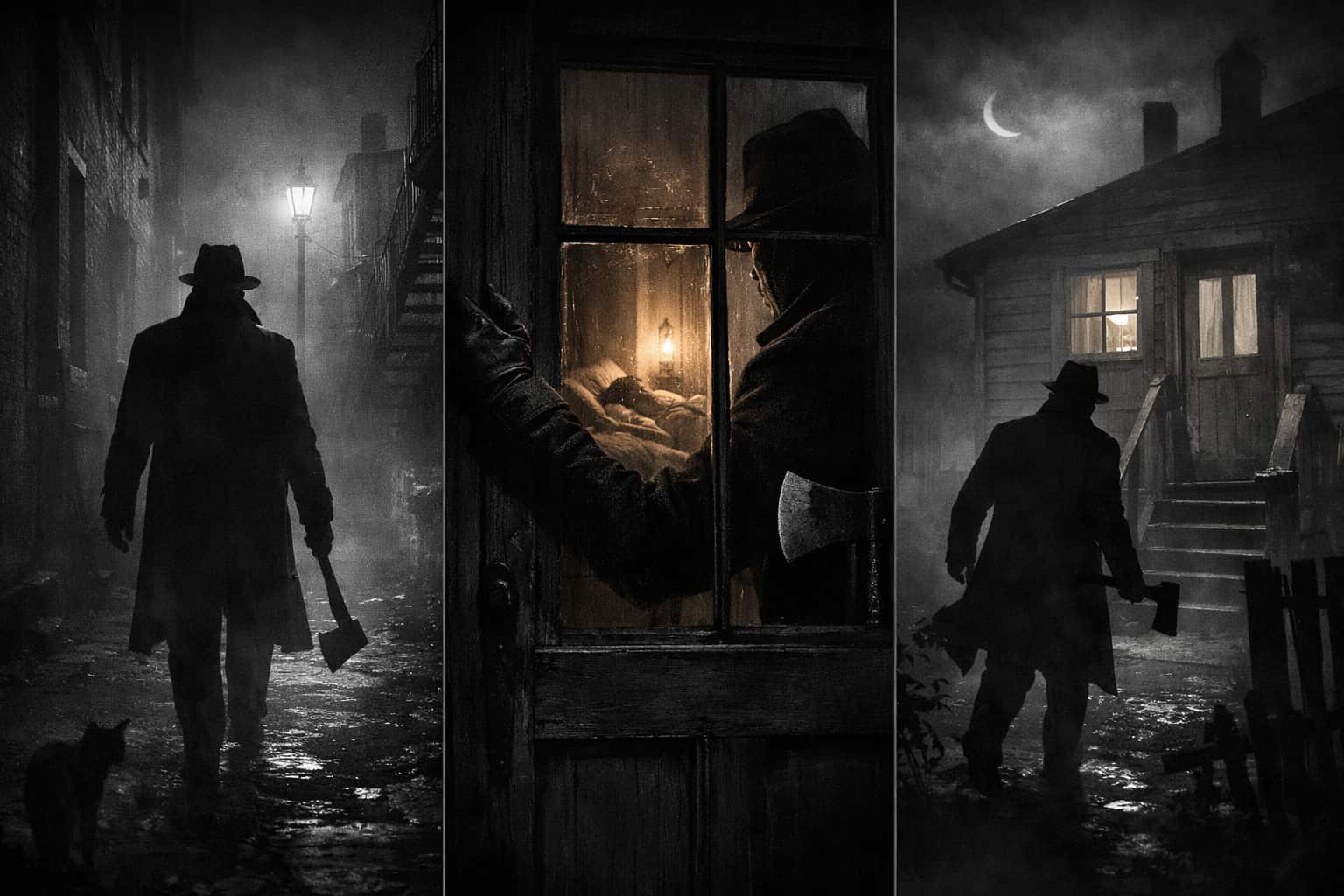
Both had been attacked in their sleep. The axe used against them was Joseph’s own — taken from his tool shed, carried into the house, and left at the scene when the killer disappeared back into the darkness.
Nobody had heard a sound.
The back door panel had been cut through with a chisel — cleanly, quietly, with the kind of deliberate patience that suggested someone who had thought carefully about how to get inside without waking anyone.
The street outside was quiet. The city was sleeping. And somewhere in that sleeping city, a killer was walking home as if nothing had happened.
The Pattern
More attacks followed through the summer and into the following year.
The pattern was always the same. Italian immigrant families. Grocers, mostly. Attacked in their own homes while they slept. The back door panel cut with a chisel. The weapon — almost always an axe — taken from somewhere on the property and left at the scene.
No witnesses. No descriptions. No clear motive that investigators could establish.
The Italian community was targeted so consistently that some investigators theorized the attacks might be connected to organized crime — the Black Hand, perhaps, using extreme violence to enforce payments or send messages. But the theory never produced evidence strong enough to lead anywhere.
New Orleans began to change.
People slept with the lights on. Families pushed heavy furniture against the back doors before going to bed. Husbands sat up through the night with guns across their laps, listening to every creak of the floorboards, every sound from the street outside.
A city that had always lived with its doors open started closing them.
The Letter
And then, in March 1919, the letter arrived.
It was delivered to the newspapers — addressed to the city itself, signed by the Axeman. And it was unlike anything New Orleans had ever seen.
The letter was strange. Almost playful. The writer described himself as a demon from the hottest hell, beyond human understanding and human law. He wrote that he would visit New Orleans again on a specific Tuesday night — but that he would pass over any house where a jazz band was playing.
He was giving the city a chance.
New Orleans took it.
On that Tuesday night, every dance hall in the city was packed. Jazz poured from homes and windows across every neighborhood — not out of joy, but out of terror. People held parties they did not want to attend, filling their houses with music they hoped would keep death from their door.
Nobody died that night.
Whether the Axeman kept his word, or whether no attack had ever been planned, or whether the whole letter was an elaborate psychological game played by someone who enjoyed the power of fear as much as the violence itself — nobody knows.
The Silence
The attacks fizzled out through 1919.
And then, quietly and completely, they stopped.
No final attack. No arrest. No confession. No dramatic ending of any kind. The Axeman simply ceased — withdrew from the historical record as cleanly and mysteriously as he had entered it, leaving behind a city of frightened people and a case full of questions that have never been answered.
Investigators pursued several suspects over the years. Names were proposed and examined and eventually set aside for lack of evidence. The most credible theories pointed toward organized crime, toward personal grievances within the Italian immigrant community, toward a single individual with a specific and terrible obsession.
None of them were ever proven.
What Remains
The New Orleans Axeman killed at least six people and injured several more between 1918 and 1919.
He was never identified. Never arrested. Never brought to any accounting for what he did.
He remains one of the most unsettling figures in American criminal history — not because of the scale of his crimes, which were limited compared to some of the cases that came after, but because of the specific quality of the terror he created. The back door. The stolen axe. The silence. The letter that turned an entire city’s nightlife into an act of desperate self-preservation.
He understood something about fear that most killers do not — that it is not the violence itself that breaks people, but the not knowing. The waiting. The lying awake at night listening to every sound and wondering whether tonight is the night.
New Orleans healed, as cities do. The jazz came back — genuinely, this time, not as a ward against death. The doors opened again. The neighbors returned to knowing each other’s names.
But somewhere in the history of those old stone streets, the Axeman is still walking home in the dark.
Still unidentified.
Still free.
The New Orleans Axeman · Active 1918–1919 · New Orleans, Louisiana
At least 6 killed · Italian immigrant families targeted
The Jazz Letter · March 1919 · City-wide response
Never identified · Never arrested · Case unsolved
If you want to read more like this, click here: The Black Dahlia — Elizabeth Short
Sources & References
- Library of Congress — Chronicling America historic newspapers: https://chroniclingamerica.loc.gov/
- The Historic New Orleans Collection — research collections: https://www.hnoc.org/research
- Library of Congress — Chronicling America historic newspapers ↗
- The Historic New Orleans Collection — research collections ↗
TaleHive separates published reporting from personal accounts and editorial context where relevant.
More from the hive
Richard McCoy and the 1972 United Airlines Skyjacking
Gilgo Beach Serial Killings — The Case That Changed in 2026