
Phil Knight — From Car Trunk to Nike
Explore the documented turning points, decisions and setbacks behind Phil Knight — From Car Trunk to Nike, with sources and an editorially reviewed…
How do you want this story?
Phil Knight — From Car Trunk to Nike
Explore the documented turning points, decisions and setbacks behind Phil Knight — From Car Trunk to Nike, with sources and an editorially reviewed… Phil Knight — From Car Trunk to Nike How a runner, a coach and a small Oregon shoe business grew into one of the world’s best-known sports companies. Before Nike had a name Phil Knight grew up in Oregon and ran track at the University of Oregon under coach Bill Bowerman. Bowerman was famous for studying every detail that might help an athlete perform better, including the construction and weight of running shoes. Knight later earned an MBA at Stanford, where he wrote about the possibility of importing high-quality Japanese running shoes…
Phil Knight — From Car Trunk to Nike
How a runner, a coach and a small Oregon shoe business grew into one of the world’s best-known sports companies.
Before Nike had a name
Phil Knight grew up in Oregon and ran track at the University of Oregon under coach Bill Bowerman. Bowerman was famous for studying every detail that might help an athlete perform better, including the construction and weight of running shoes. Knight later earned an MBA at Stanford, where he wrote about the possibility of importing high-quality Japanese running shoes into the United States.
After Stanford, Knight traveled to Japan and met executives at Onitsuka, maker of Tiger running shoes. He presented himself as a representative of a business he called Blue Ribbon Sports and arranged to distribute the company’s shoes in the United States. The operation was modest: shoes were shipped to Oregon, stored at Knight’s parents’ home and sold directly to runners and coaches.
The handshake that became Blue Ribbon Sports
Nike’s own archives date the partnership between Knight and Bowerman to January 25, 1964. Knight brought the sales idea and the willingness to build a market; Bowerman brought deep knowledge of runners and footwear. A shipment of roughly 300 pairs arrived at Knight’s parents’ house in April 1964, and the basement laundry room became an improvised warehouse.
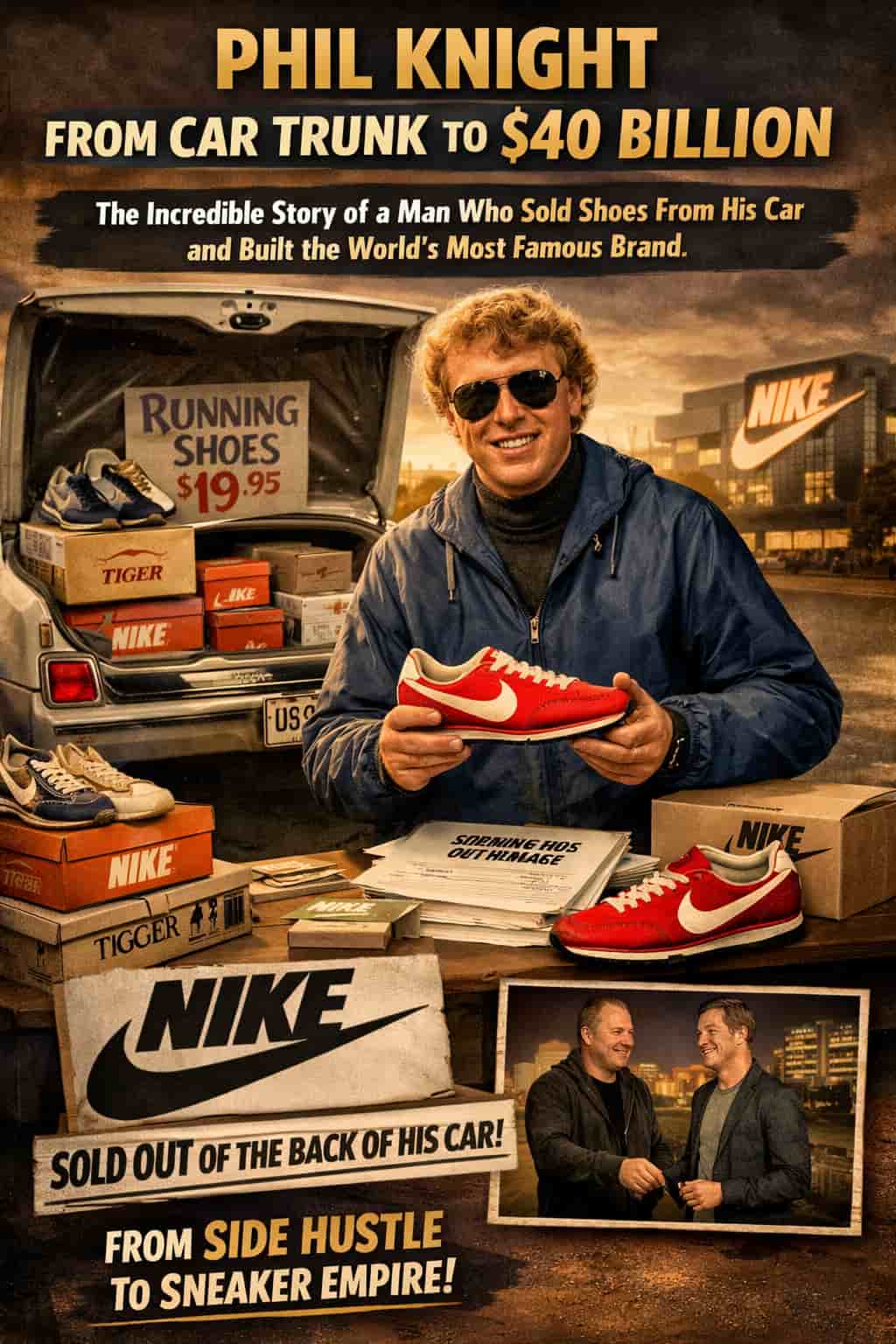
Knight loaded shoes into his Plymouth Valiant and drove to track meets and schools around the Pacific Northwest. Selling directly mattered because he understood the customer: he had been a runner himself, knew coaches, and could talk about fit and performance rather than simply display a product on a shelf.
From distributor to brand
By the end of the 1960s, Blue Ribbon Sports had employees, shops and a growing customer base. But dependence on a single Japanese supplier created risk. The company began developing footwear under its own identity. In 1971, graphic design student Carolyn Davidson created the Swoosh for $35, and the Nike name—drawn from the Greek goddess of victory—became attached to the new line.
Bowerman’s product experiments helped shape Nike’s early reputation. He had spent years modifying shoes for athletes and later became associated with the waffle-sole idea that helped define Nike running footwear in the 1970s. The company was not built by one breakthrough alone; it was built through repeated testing, selling, borrowing, manufacturing problems and a willingness to keep moving while cash was tight.
Going public and building a culture
Nike grew rapidly during the running boom and went public in 1980. Its next great expansion came through athlete partnerships and marketing. The Air Jordan relationship, launched after Nike signed Michael Jordan in 1984, demonstrated that athletic shoes could be performance equipment, fashion and cultural identity at the same time.
Knight served in senior leadership roles for decades and later became chairman emeritus. His story is often reduced to the image of shoes sold from a car trunk, but the larger lesson is about distribution, product insight, brand building and surviving repeated moments when a young company could easily have failed.
Why the story still matters
The early Nike story is useful because it is not a simple overnight-success tale. It began with a specific customer problem, a small shipment, direct selling and a partnership between business instinct and athletic experimentation. That combination—plus years of risk—turned Blue Ribbon Sports into Nike.
Why the early Nike model worked
Blue Ribbon Sports began with an advantage that had nothing to do with a giant advertising budget: its founders were close to the people using the product. Bowerman coached runners and modified shoes because he saw where existing equipment failed. Knight knew the same community as a former athlete and could sell face to face. That feedback loop mattered. A shoe was not an abstract consumer good; runners could immediately tell the founders whether it fit, lasted and performed as promised.
The company also learned distribution before it became a manufacturer. Importing Onitsuka Tiger shoes forced Knight to understand ordering, cash flow, inventory, shipping and the basic problem of getting a product into a customer’s hands. When the supplier relationship became unstable, Blue Ribbon Sports had already built relationships with runners and retailers. Creating its own brand was risky, but it did not start from zero.
Nike’s later scale can make the beginning look inevitable. It was not. The early company operated with limited capital and recurring financial pressure. Growth required borrowing, forecasting demand and committing to inventory before sales were certain. That history makes the car-trunk image useful for more than mythology: it captures a period when customer knowledge and persistence mattered more than corporate infrastructure.
The Swoosh, athlete relationships and product innovations eventually turned a small distributor into a global brand, but each came after years of learning. For TaleHive, the strongest lesson is not “start with nothing and become a billionaire.” It is more specific: get close to a real problem, understand the user, build a way to reach that user, and keep improving the product while the organization is still small enough to learn quickly.
Sources & References
- Nike — Phil Knight profile: https://about.nike.com/en/company/people/philip-h-knight
- Nike Archives — The Handshake That Started It All: https://about.nike.com/en-GB/magazine/the-handshake-that-started-it-all
- Phil Knight, Shoe Dog (memoir, 2016)
- Nike — Phil Knight profile ↗
- Nike Archives — The Handshake That Started It All ↗
- Phil Knight, Shoe Dog (memoir, 2016)
TaleHive separates published reporting from personal accounts and editorial context where relevant.
More from the hive
Jan Koum — From Food Stamps to WhatsApp
Michael Dell — From Dorm Room to Dell Technologies