The 1962 Alcatraz Escape — What Is Known
A non-graphic, source-based look at The 1962 Alcatraz Escape — What Is Known, separating documented facts from allegations, uncertainty and later…
How do you want this story?
The 1962 Alcatraz Escape — What Is Known
A non-graphic, source-based look at The 1962 Alcatraz Escape — What Is Known, separating documented facts from allegations, uncertainty and later… The 1962 Alcatraz Escape — What Is Known Alcatraz Island – June 11, 1962. The Astonishing Night 3 Men Broke Out Of America’s Most Dangerous Prison Some make their own fate. That was not the Anglin brothers and Frank Morris. On the top of the most escape-proof prison in America, three men had spent months carving holes in the walls. They crawled through those holes and climbed to the roof in the early hours of June 11, 1962. They slid down to the rocky shore of AlcatrazAlcatraz Island, inflated a homemade raft made from…
The 1962 Alcatraz Escape — What Is Known
Alcatraz Island – June 11, 1962.
The Astonishing Night 3 Men Broke Out Of America’s Most Dangerous Prison
Some make their own fate.
That was not the Anglin brothers and Frank Morris.
On the top of the most escape-proof prison in America, three men had spent months carving holes in the walls. They crawled through those holes and climbed to the roof in the early hours of June 11, 1962. They slid down to the rocky shore of AlcatrazAlcatraz Island, inflated a homemade raft made from stolen raincoats and pushed out into the freezing black water of San Francisco Bay.
No one has seen them since.
Did the bay take them, or did it let them go? Did it drown them in the dark water between the island and the mainland, or walk them out the other side into new lives under new names? This is a question that has never been answered, and probably never will be.
The case is still pending.
Rock
In order to understand what Frank Morris and the Anglin brothers did, you have to understand what Alcatraz was.
Alcatraz Federal Penitentiary was more than just a prison, it was on a small island in the middle of San Francisco Bay. It was a declaration, the declaration of the American government, that some criminals were too dangerous, too irredeemable, too bent on escape for ordinary prisons to hold them. Alcatraz was where you put the men other prisons could not handle.
The main security feature was the island itself. Alcatraz was a mile and a quarter from the San Francisco shoreline and the water was cold and fast and freezing, so cold and so fast that the prison authorities considered it more reliable than any wall or fence they could build. The bay would do their job for them, guards were assured, with complete conviction.
No one had ever escaped from Alcatraz But Frank Morris had other plans.
The Plan:
By any measure Frank Morris was an extraordinarily intelligent man. His IQ was so high the prison records listed it as genius range. He would also spent enough of his life in and out of the corrections system to know how it operated, where its weaknesses were, and how a patient, determined enough person could exploit those weaknesses.
John and Clarence Anglin were brothers from a large farming family in Georgia. They were seasoned bank robbers, who had previously tried to escape from other prisons before being sent to Alcatraz. They were resourceful, disciplined and, crucially, willing to commit to a plan that would take months of patient, invisible work.
During the first months of 1962, the three men started to plan their escape.
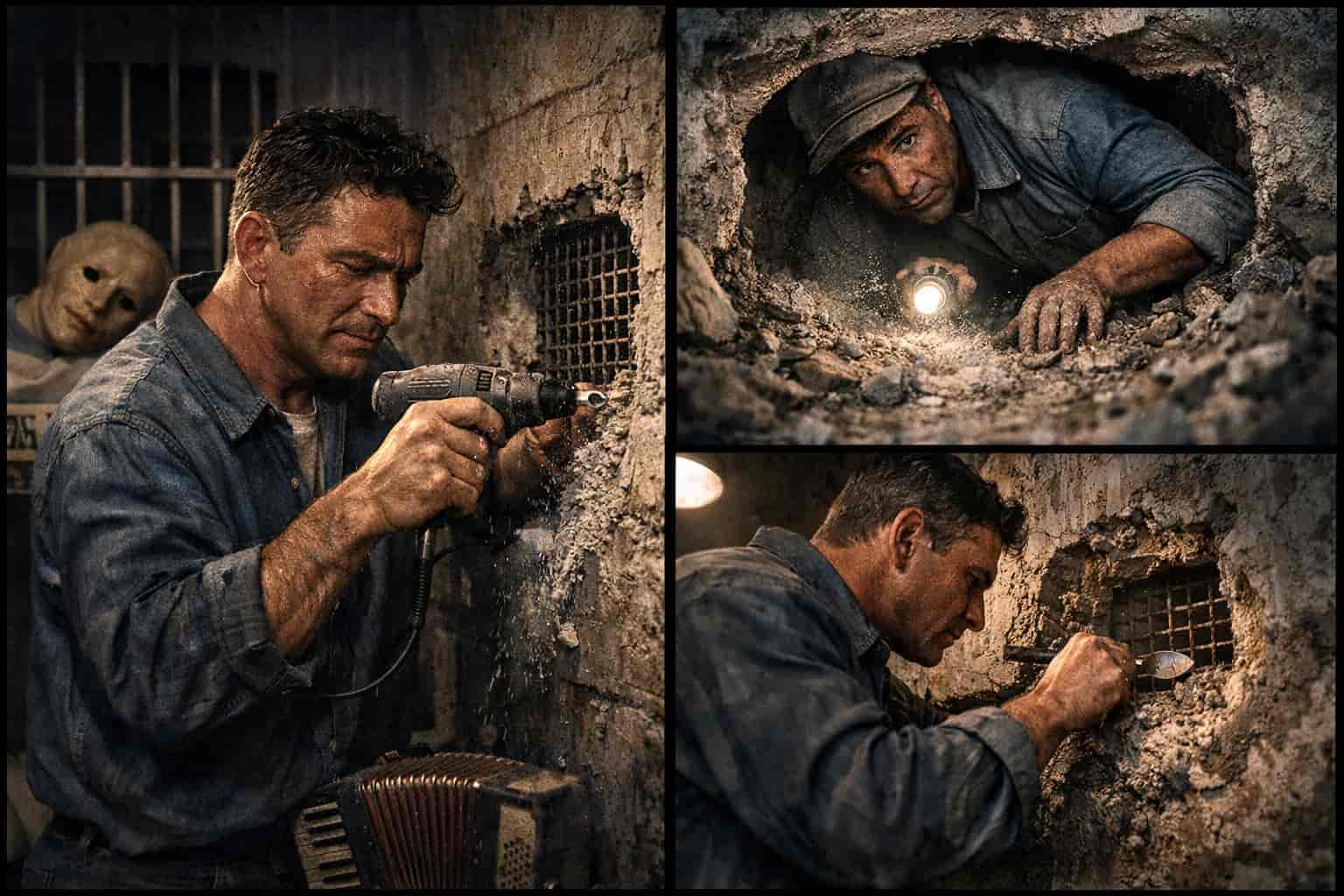
The first job was the walls. The cells in B Block at Alcatraz were old, the concrete crumbling after decades of salt air and the moisture of the bay. Morris had found that the concrete around the ventilation grates at the back of each cell could be chipped away, slowly, quietly, invisibly, with the right tools.
For Alcatraz, the right tools were sharpened spoon handles and a makeshift drill from the motor of a stolen vacuum cleaner.
After lights out, every night, the men went to work. One of them played an accordion, a cover for the scraping and drilling sounds coming from the cells. Night after night the others chipped away the concrete, taking away material and replacing it with a painted cardboard panel that, to the flashlight beam of a guard on routine rounds, looked exactly like the original wall.
As they dug, they built.
What They Created
“What Morris and the Anglins did with the prison stuff is just brilliant.
They made a raft out of more than fifty stolen raincoats, stitching the rubber together, sealing the seams, building something they thought could carry three men across San Francisco Bay. They made life preservers out of the same stuff. They made paddles out of wood.
And they solved the problem that had foiled every other escape attempt from Alcatraz – the nightly cell checks.
After lights out, guards made rounds, shining flashlights into the cells to see if each prisoner was in his bunk.
Morris and the Anglin brothers fashioned dummy heads from a mixture of soap, concrete dust and real human hair from the prison barbershop and, propped on a pillow under a blanket, they were realistic enough to fool the inspection in the dark.
The dummies slept in their bunks. The real men worked every night.
The Night June 11, 1962
Everything was ready after months of preparation.
The three men took down the panels they had been using to hide their progress, after lights out, and crawled through the holes they had cut in the backs of their cells. They made their way to a utility corridor behind the cell block, climbed the plumbing pipes that ran up the back wall and emerged on the roof of the cell house.
They went over the roof. They landed on the stony northeastern shore of the island. They blew up their raft, put it on the rocks and pushed out into the black water of San Francisco Bay.
The water that night was about fifty degrees. The bay has very strong and dangerous currents. It was one and a quarter miles to the mainland.
Paddling into the darkness they were gone.
The Next Day
The next morning, during the regular count, a guard approached Frank Morris’s cell.
He put his hand on the shoulder of the man in the bunk.
The dummy head rolled off the pillow and on to the floor.
The alarm went off right away. The Coast Guard was called. Aircraft searched Bay. ( Within the hour, FBI agents were on the island.
It was thin, they found.
Wooden paddle in water near Angel Island. One of the raft’s rubber pieces washed ashore on the Marin County shoreline. A waterproof bag containing personal effects of the Anglin brothers.
No corpses. Nobody made it. No sign of living human beings three of them.
The Inquiry
The FBI spent 17 years investigating the Alcatraz escape.
Their conclusion, after a careful study of the currents, water temperature, raft construction, and the physical demands of the crossing, was that Frank Morris and the Anglin brothers had all but certainly drowned in San Francisco Bay. Bad night for the weather. The raft was a jury job. No wetsuits. No navigation equipment. No certainty that the currents would take them toward the mainland, not out toward the open ocean.
The FBI ended its investigation in 1979.
The case wasn’t closed by the United States Marshals Service. Their policy is simple – you don’t close a case without bodies.” Frank Morris and John and Clarence Anglin are still at large and no one is confirmed dead.
The evidence leaves the question open
Decades after the escape, evidence has emerged that makes the FBI’s conclusion more complicated.
A letter appeared – allegedly from John Anglin – claiming that all three men had made it across and were living under assumed names. The authenticity of the letter has never been verified.
In 2013, a picture surfaced of two men in Brazil who looked like the Anglin brothers — older, tanned, seemingly free. The investigators examined the photograph and couldn’t draw any conclusions.
For over sixty years the Anglin family has quietly and steadfastly insisted that John and Clarence made it. They talk of it not as a hope, but as a fact, the kind of certainty that arises from family knowledge, not from public evidence.
No one outside the family, if anyone, knows for sure.
The Legacy
In 1963, one year later, Alcatraz Federal Penitentiary closed. Official reasons cited the high cost of running a facility on an island and the declining condition of the buildings. The escape of Morris and the Anglins and the questions it raised about the prison’s security surely played a role in the decision.
Today Alcatraz is a museum and is one of the most popular tourist attractions in San Francisco. Every year, millions of people walk through its cell blocks. And almost all of them end up in B Block — in the three cells where you can still see the holes in the back walls, where the story of June 11, 1962 begins.
Three men sat in the most secure prison in America, and thought the water outside was worth the risk.
They picked up a spoon and began to dig.
No one knows whether the bay captured them or set them free.
This matter is still open.
Frank Morris · John Anglin · Clarence Anglin
Escaped Alcatraz Jun 11, 1962 San Francisco Bay FBI investigation closed 1979 U.S. Marshals case still open Fate unknown Never found
If you want to read more like this, click here: The Day the Sky Fell New York City
Sources & References
- FBI — Alcatraz Escape: https://www.fbi.gov/history/cases-and-criminals/alcatraz-escape
- National Park Service — Alcatraz history: https://www.nps.gov/alca/learn/historyculture/index.htm
TaleHive separates published reporting from personal accounts and editorial context where relevant.
More from the hive

Richard McCoy and the 1972 United Airlines Skyjacking
Gilgo Beach Serial Killings — The Case That Changed in 2026