White Lady —Various locations across America
Explore the folklore, history and reported traditions behind White Lady —Various locations across America. Supernatural claims are presented as legend,…
How do you want this story?
White Lady —Various locations across America
Explore the folklore, history and reported traditions behind White Lady —Various locations across America. Supernatural claims are presented as legend,… The White Lady Various Locations Across America There is a figure that appears in the folklore of nearly every culture on earth. She is always the White Lady. She is always dressed in white. She is always connected, in one way or another, to something that ended badly — a death that came too soon, a love that did not survive, a loss so complete that something of the person who suffered it never fully departed from the place where it happened. In Mexico, she is La Llorona, a weeping white lady who wanders the…
The White Lady
Various Locations Across America
There is a figure that appears in the folklore of nearly every culture on earth.
She is always the White Lady. She is always dressed in white. She is always connected, in one way or another, to something that ended badly — a death that came too soon, a love that did not survive, a loss so complete that something of the person who suffered it never fully departed from the place where it happened.
In Mexico, she is La Llorona, a weeping white lady who wanders the rivers at night, calling for her drowned children. In the Philippines she is the White Lady of Balete Drive, standing motionless at the roadside in the dark.
In Britain she haunts castle corridors and country roads in equal measure, a pale figure glimpsed at the edge of candlelight and then gone. In Japan, in Ireland, in Brazil, in South Africa — every culture, every continent, every era of human history has produced its own version of essentially the same story.
America has dozens of them.
Some are vague and poorly documented — a local legend passed around a small town for a generation or two before fading out completely. But others are something different. Others have accumulated decades of consistent, independent witness accounts that follow patterns too specific and too persistent to be explained away as imagination or coincidence.
These are the most documented. The most reported. The ones that have refused, across many decades of scrutiny, to simply go away.
Resurrection Mary — Chicago, Illinois
If you are going to talk about the White Lady in America, you begin here.
Resurrection Mary is the most famous White Lady story this country has ever produced, and she has been producing witnesses for nearly a century. The story begins in the 1930s on Archer Avenue on the southwest side of Chicago — a long, straight road that runs past Resurrection Cemetery on its way through a stretch of the city that feels, even in daylight, slightly removed from the ordinary world.
Young men began reporting the experience independently of one another, with no apparent connection between the accounts and no way to coordinate the details they described.
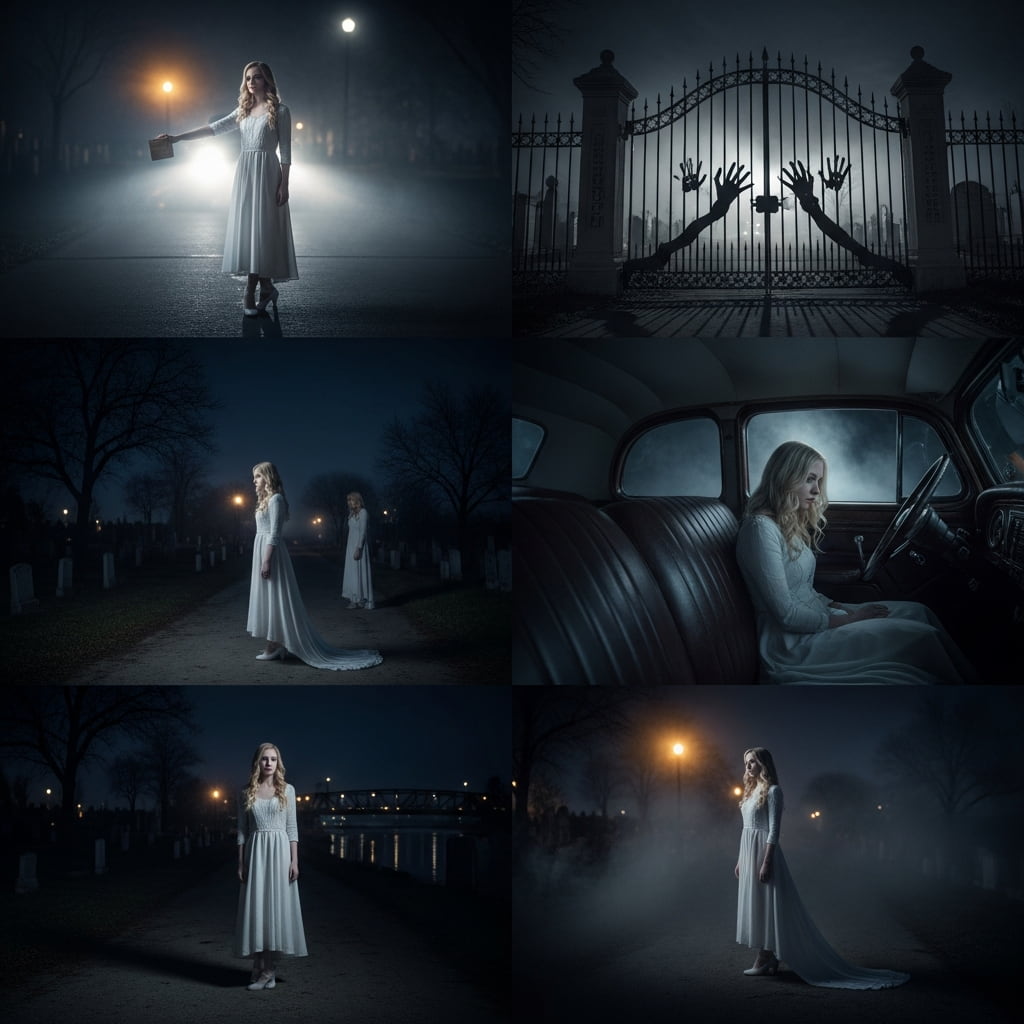
The pattern was always the same. A man driving alone on Archer Avenue late at night would notice a young white lady walking along the road — blonde, pale, dressed in white, wearing white dancing shoes that seemed wrong for the weather and the hour. He would stop and offer her a ride. She would get in.
She would be cold to the touch if he made contact with her arm or her hand — not cool the way a person is cool after being outside on a winter night, but cold in a way that did not feel like a living person’s temperature.
She would give an address or indicate she wanted to go toward the cemetery. And then, as the car passed the gates of Resurrection Cemetery, she would simply cease to be in the passenger seat. No door opening.
No sound. No movement. She would be there, and then she would not be there, and the man would be sitting alone in a car on Archer Avenue at two in the morning trying to understand what had just happened.
This continued for decades. Different men, different years, same description every time. Young. Blonde. White dress. White dancing shoes. Pale blue eyes. Cold skin. Gone at the cemetery gates.
The details accumulated in a way that is difficult to explain if the entire phenomenon is simply a matter of people imagining things or repeating a story they heard somewhere.
The descriptions were too consistent across accounts that had no connection to each other. The witnesses were not people who went looking for her — they were people who stumbled into the experience without any intention of doing so.
And then, in 1976, something happened that moved the story out of the realm of witness testimony and into something more concrete.
The caretaker of Resurrection Cemetery noticed that two of the iron bars on the cemetery’s front gate had been bent outward — not broken, not cut, but bent, as though significant force had been applied from the inside pushing out.
And pressed into the metal of those bars were marks that looked, unmistakably, like handprints. Small handprints. The size of a woman’s hands, pressed into the iron as though the metal had been soft when the contact was made, or as though whatever made those impressions had exerted a force that ordinary human hands should not have been capable of producing.
The cemetery photographed the bars, removed them, and replaced them. The official explanation was that a truck had accidentally backed into the gate and caused the damage. The handprint-shaped impressions in the metal were not addressed directly in any official statement.
Nobody who looked at the photographs found that explanation convincing.
Resurrection Mary has continued to be reported on Archer Avenue from the 1930s through to the present day. The witnesses span generations. The descriptions have not changed. The location has not changed. Whatever is happening on that road at night has been happening for the better part of a century, and it has not shown any signs of stopping.
According to Wikipedia’s documentation on Resurrection Mary, she remains one of the most well-attested ghost legends in the United States — a case with more independent witnesses over a longer sustained period than almost any comparable story in American folklore.
Why She Keeps Appearing
The White Lady, in all her forms across all her locations, is not simply a ghost story in the conventional sense. She is something that cultures keep producing independently of each other, across centuries and continents, in ways that suggest she is expressing something true about human experience rather than simply being a piece of fiction that got repeated enough times to feel real.
She is always a White Lady. She is always connected to loss. She is always at a threshold — a road, a bridge, a cemetery gate, the edge of water. She is always caught between something she cannot leave behind and somewhere she cannot fully return to.
The details shift depending on the culture and the location. The core of the story does not shift at all.
There is something in the human experience of grief — particularly the grief of a sudden, violent, or unjust death — that resists the ordinary process of fading and being forgotten. Something that insists on remaining visible.
Something that keeps appearing on the same road, in the same white dress, at the same hour of the night, generation after generation, because the loss that produced it was too significant to simply dissolve into silence the way ordinary things dissolve into silence over time.
She stands at the roadside. She accepts the ride. She vanishes at the gate.
And she keeps coming back.
She Has Always Been Here
America is a young country by the standards of most of the world, but it is not too young to have accumulated its own weight of grief and loss and sudden endings.
The White Lady appears in this landscape the same way she appears in every other landscape — drawn to the places where something went wrong, anchored to the roads and bridges and cemetery gates that mark the boundaries between one world and another.
Dozens of versions of her have been documented across the country. Different names, different states, different specific stories attached to different specific locations. But the same essential figure, moving through the same essential darkness, connected to the same essential truth about what grief does when it has nowhere left to go.
She does not fade. She does not stop appearing. She does not respond to official explanations about trucks backing into cemetery gates.
She simply continues. White dress. Cold hands. Gone at the gate.
Still out there on Archer Avenue tonight, if the hour is late enough and the road is quiet enough, waiting for the next set of headlights to slow down and stop.
The White Lady · Documented across America · Resurrection Mary, Chicago · First reported 1930s · Still being reported today.
If you want to read more like this, click here: The Gray Man — Pawleys Island, South Carolina
Sources & References
- Chicago History Museum — Resurrection Mary, the hitchhiking ghost of Archer Avenue: https://www.chicagohistory.org/resurrection-mary/
- Library of Congress — American Folklife Center collections: https://www.loc.gov/folklife/
- Chicago History Museum — Resurrection Mary, the hitchhiking ghost of Archer Avenue ↗
- Library of Congress — American Folklife Center collections ↗
TaleHive separates published reporting from personal accounts and editorial context where relevant.
More from the hive
 🎧 Audio Available
The School the World Forgot
Villisca Axe Murders – 1912