Villisca Axe Murders – 1912
A source-based TaleHive feature on Villisca Axe Murders – 1912, separating documented history from theories, folklore and unresolved questions.
How do you want this story?
Villisca Axe Murders – 1912
A source-based TaleHive feature on Villisca Axe Murders – 1912, separating documented history from theories, folklore and unresolved questions. Villisca Axe Murders – 1912 The Horrifying Night 8 People Were Killed in Iowa and No One Was Ever Caught Some crimes are so brutal they leave a permanent mark on a place. One of those places is VilliscaVillisca, Iowa. On the night of June 9, 1912, a quiet family home on a quiet street in a quiet midwestern town was invaded by someone who murdered eight people in their sleep. Six of them children. No one heard a sound. Nobody saw anything. No one has ever been convicted of the crime in the more than…
Villisca Axe Murders – 1912
The Horrifying Night 8 People Were Killed in Iowa and No One Was Ever Caught
Some crimes are so brutal they leave a permanent mark on a place.
One of those places is VilliscaVillisca, Iowa.
On the night of June 9, 1912, a quiet family home on a quiet street in a quiet midwestern town was invaded by someone who murdered eight people in their sleep. Six of them children.
No one heard a sound. Nobody saw anything. No one has ever been convicted of the crime in the more than one hundred years since that terrible night.
Villisca Axe Murders – 1912
are still one of the most chilling and most thoroughly researched unsolved mass murders in American history — a case that has haunted investigators, historians, and true crime researchers for more than a century, and shows no sign of releasing its grip on the public imagination anytime soon.
A Town Like Any Other
Villisca was a small, prosperous farming community in southwestern Iowa in 1912 — the sort of place where folks knew their neighbors, where kids played in the streets until dark and the idea of locking your door at night would have seemed almost insulting to the community’s sense of safety.
Villisca Axe Murders – 1912
The Moore family was the heart of that community.
Josiah Moore was a respected businessman, a successful implement dealer who had established a comfortable life for his family in Villisca. His wife Sarah was known and liked all over town. They had four children together, Herman, Mary, Arthur, and Paul, ranging in age from five to eleven years
.
On the evening of June 9, 1912, the Moore family attended a children’s program at their local Presbyterian church. They had two neighborhood girls, Lena and Ina Stillinger, ages eight and twelve, come back home with them for a sleepover.
That night eight people slept at the Moore house.
None of them opened their eyes.
The Morning After:
A neighbor was the first to realize something was wrong.
The Moore house was uncommonly quiet that morning of June 10, according to Mary Peckham, who lived next door. No motion. No cooking sounds. No kids coming out to play. They had the curtains drawn in a manner that seemed strange for a bright summer morning.
She knocked. No response.
She tried the door. Closed.
More and more alarmed, she rang Josiah Moore’s brother Ross, who had a key. When Ross Moore unlocked the front door and stepped inside, he was confronted with a scene of almost unbelievable horror.
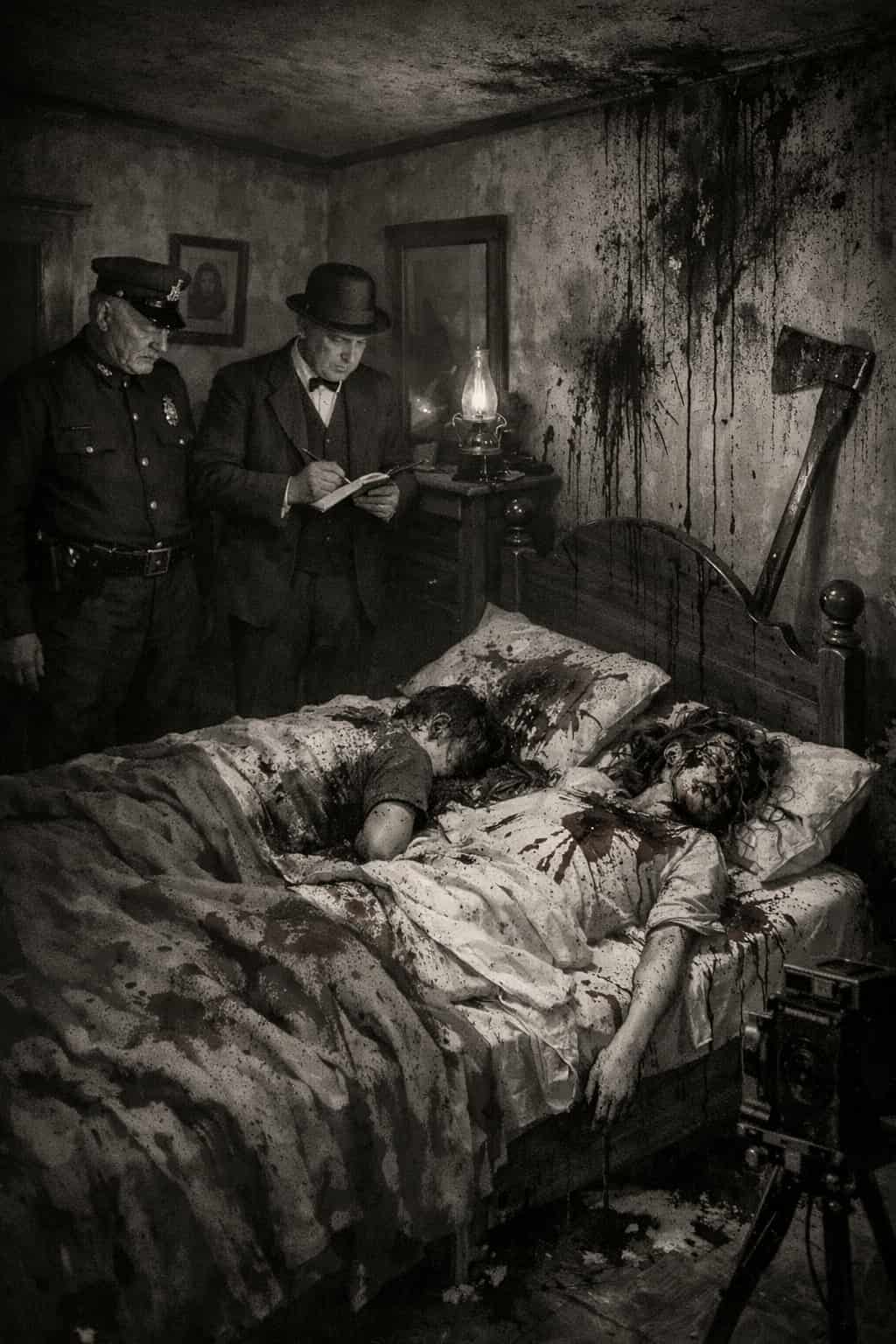
Eight people had been hacked to death in their beds. Every victim had been beaten again and again, and with great force. All the mirrors in the house were draped with cloth. The axe – Josiah Moore’s own axe – had been left in the house, wiped but not cleaned.
The two Stillinger girls were dead in the guest room on the first floor. The Moore family had been killed upstairs in their beds.
A slab of bacon had been discovered on the ground near the bodies, stolen from the Moore family’s own icebox. A two pound piece of food, left by the perpetrators of the murders next to the victims for reasons never satisfactorily explained.
The Inquiry
Villisca Axe Murders – 1912 investigation was thorough, by 1912 standards.
The case immediately drew national attention. It was feverishly reported in newspapers all over the country. In the days after the discovery, investigators, reporters and curious onlookers flooded into the town of Villisca.
The crime scene was, by modern forensic standards, catastrophically compromised almost immediately, simply due to the sheer number of people who walked through it before proper investigation could take place.
In the years that followed, a number of suspects came forward.
The most notable was a traveling minister named Reverend George Kelly who had been at the same church program as the Moore family the night of the murders. Kelly was known for erratic behavior and made several confusing and contradictory statements about where he was that night.
He stood trial twice for the murders, once in 1917, and both trials resulted in no conviction. The first was a hung jury. The second trial ended in a not guilty verdict.
Another major suspect was Frank Jones, a former business partner of Josiah Moore with a documented grievance against him. Jones was accused by private investigators hired by the Moore family, and the theory was that he had hired a professional killer named William Mansfield to carry out the murders.
Mansfield was questioned but no charges were laid against him.
Over the years, other suspects were questioned, including a traveling serial killer believed to have committed similar axe murders in other midwestern communities around the same time — a chilling suggestion that Villisca Axe Murders – 1912 may have been part of a larger pattern of killings by the same individual.
None of these leads ever resulted in a conviction.
The Clues That Did Not Make Sense
What keeps the Villisca Axe Murders – 1912 so stubbornly interesting to investigators and researchers is the collection of peculiar details that point in several directions at once.
The covered mirrors point to someone with particular psychological traits: a killer who couldn’t stand to see himself in the mirror, or someone carrying out a ritual that investigators have never been able to fully decipher.
The bacon found near the corpses shows that the murderer remained in the house for some time after the crime, going from room to room, opening the icebox, taking food, behaving after a fashion that tells either of remarkable cold-bloodedness or a psychological condition that cannot be easily classified.
The fact that the axe was a Moore family heirloom suggests opportunism or prior knowledge—a killer who knew the layout of the house well enough to find the weapon without having to search for it.
And the fact that no disturbance was witnessed — in a house with neighbors all around it, on a quiet residential street — speaks to a level of speed and silence that suggests either extraordinary luck or extraordinary planning.
None of it points clearly in any one direction. All of it together paints a portrait of a killer – or killers – as much a mystery today as they were the morning of June 10, 1912.
The House That Remembers
The Moore house remains in Villisca, Iowa.
It has been preserved as a historic site and is open to visitors, including overnight stays for those brave enough to stay in the house where eight people were murdered in their beds. It has been visited widely by paranormal investigators. Ghost hunters have spent nights inside of it. They’ve combed it from stem to stern.”
The house has become a pilgrimage site for those who want to know about the darkest corners of American history — a tangible monument to a crime the justice system could never figure out.
Villisca itself — a town of fewer than a thousand people today — carries the weight of that June night in 1912 in ways both visible and invisible. It’s now a part of the community’s identity, woven into its history, the kind of story that gets passed down through generations whether the people passing it down want it to or not.
The Question Still
Over one hundred and ten years after eight people were killed in their sleep in a sleepy Iowa farmhouse, the Villisca Axe Murders – 1912 officially remain unsolved.
Nobody was ever convicted. And no one ever made a confession that investigators deemed credible and complete. The axe that killed eight people on a June night in 1912 was never definitively tied to anyone.
Somewhere in the long history of this case — in the trial transcripts, in the investigative records, in the oral histories passed down through Villisca families — the truth may lie.
Or maybe the person who went into that house, covered those mirrors, picked up that axe, and slipped away into the Iowa night just got away with it totally.
The night of June 9, 1912, eight people went to bed in Villisca, Iowa.
They deserved better than the century of silence which followed.
Villisca Axe Murders – 1912 · Villisca, IA · June 9–10, 1912;
8 victims: Josiah Moore, Sarah Moore, 4 Moore children, 2 Stillinger girls
Main suspects: Reverend George Kelly, Frank Jones · Not convicted
Case status: Unofficially unsolved
Another prime suspect was Frank Jones, who had a documented grievance against Moore, and who had also been his business partner. Jones was accused by private investigators hired by the Moore family, who theorized that he had hired professional killer William Mansfield to commit the murders.
Mansfield was questioned but not charged.
Through the years, other suspects were interviewed including a traveling serial killer who is suspected of committing similar axe murders in other midwestern communities around the same time — a chilling implication that Villisca Axe Murders – 1912 may have been part of a larger pattern of killings by the same person.
None of these leads ever led to a conviction.
The Clues That Made No Sense
The Villisca Axe Murders – 1912 offer a collection of strange details that point in a few directions at once, and that’s what makes them so stubbornly interesting to investigators and researchers.
The covered mirrors suggest someone with specific psychological characteristics: a killer unable to look at himself in the mirror, or someone performing a rite that investigators have never been able to decipher completely.
The bacon found about the corpses shows that the killer remained in the house some time after the crime, moving from room to room, opening the icebox, taking food, acting after a fashion that speaks of either remarkable cold-bloodedness or a psychological condition that cannot easily be classified.
The axe was a Moore family heirloom, meaning either opportunism, or foreknowledge; a killer who knew the layout of the house well enough to find the weapon without having to look for it.
And the fact that no disturbance was witnessed – in a house with neighbors all around it, on a quiet residential street – speaks to a level of speed and silence that suggests either extraordinary luck or extraordinary planning.
None of it points unambiguously in any one direction. Together it all paints a portrait of a killer – or killers – as much a mystery today as it was the morning of June 10, 1912.
The House That Remembers –
The Moore house is still in Villisca, Iowa.
It has been kept as a historic site and is open to visitors, including overnight stays for those brave enough to stay in the house where eight people were murdered in their beds. It has been thoroughly investigated by paranormal investigators. Ghost hunters have spent nights inside it. They’ve been through it stem to stern.”
The house has become a mecca for those who want to know about the darkest corners of American history, a physical monument to a crime the justice system could never solve.
Villisca itself, a town of less than a thousand people today, carries the weight of that June night in 1912 in both tangible and intangible ways. It’s part of the community’s identity now, part of its history, the kind of story that gets passed down through generations whether the people passing it down want it to or not.
The Question Is Still Open
More than 110 years after eight people were killed in their sleep in a sleepy Iowa farmhouse, the Villisca Axe Murders – 1912 officially remain unsolved.
No one was ever found guilty. And no one ever made a confession that investigators found credible and complete. The axe that killed eight people on a June night in 1912 was never definitively linked to anyone.
Somewhere in the long history of this case — in the trial transcripts, in the investigative records, in the oral histories passed down through Villisca families — the truth may be found.
Or maybe the person who walked into that house, covered those mirrors, picked up that axe and slipped away into the Iowa night got away with it completely.
On the night of June 9, 1912 eight people went to bed in Villisca, Iowa.
They deserved better than the silence that followed for a hundred years.
Villisca Axe Murders – 1912 f · Villisca, IA · June 9-10, 1912; 8 victims: Josiah Moore, Sarah Moore, 4 Moore children, 2 Stillinger girls
Prime suspects: Reverend George Kelly, Frank Jones · Not convicted
Status: Unofficially unsolved
If you want to read more like this, click here: Flannan Isle Lighthouse-1900- Three Keepers Vanished
Sources & References
- Iowa Legislature — 1912 Axe Murders in Villisca Remain Unsolved: https://www.legis.iowa.gov/docs/publications/TB/663533.pdf
TaleHive separates published reporting from personal accounts and editorial context where relevant.
More from the hive

The Thing That Fell From the Sky Roswell New Mexico