Flannan Isle Lighthouse — 1900 — Three keepers vanished
A source-based TaleHive feature on Flannan Isle Lighthouse — 1900 — Three keepers vanished, separating documented history from theories, folklore and…
How do you want this story?
Flannan Isle Lighthouse — 1900 — Three keepers vanished
A source-based TaleHive feature on Flannan Isle Lighthouse — 1900 — Three keepers vanished, separating documented history from theories, folklore and… Flannan Isle Lighthouse – 1900 The Strange Vanishing of 3 Lighthouse Keepers Without a Trace Some mysteries just aren’t going to get solved. Some disappearances leave just enough evidence to torment – a half-eaten meal, an overturned chair, a clock stopped at an impossible time – but not nearly enough to explain what actually happened. And that’s exactly what the Flannan IsleFlannan Isle Lighthouse 1900 was like. Three veteran lighthouse-keepers. A remote Scottish island. A light that had gone out. And then the relief boat arrived — nothing. No bodies. No explanation. No bye.…
Flannan Isle Lighthouse – 1900
The Strange Vanishing of 3 Lighthouse Keepers Without a Trace
Some mysteries just aren’t going to get solved.
Some disappearances leave just enough evidence to torment – a half-eaten meal, an overturned chair, a clock stopped at an impossible time – but not nearly enough to explain what actually happened.
And that’s exactly what the Flannan IsleFlannan Isle Lighthouse 1900 was like.
Three veteran lighthouse-keepers. A remote Scottish island. A light that had gone out. And then the relief boat arrived — nothing. No bodies. No explanation. No bye.
Just silence and a series of clues that have confounded investigators, historians and researchers for more than a century.
The Island at World’s End: Flannan Isle Lighthouse – 1900
To understand what happened on Flannan Isle you first have to understand where Flannan Isle is.
It is in the Outer Hebrides, off the northwestern coast of Scotland a small, brutal rock jutting out of one of the most unforgiving stretches of ocean in the world.
The seas around it are famous for their violence. Storms come roaring out of the Atlantic, building up force over thousands of miles of open water before smashing into the Scottish islands with a power that has sunk ships and taken lives for centuries.
The Flannan Isle Lighthouse 1900 was built to alert ships to avoid these waters. The line had been in operation only a year when the events of December, 1900, took place.
There were three men there, James Ducat, the principal keeper, Thomas Marshall, the second keeper, and Donald McArthur, the casual keeper, who was standing in for a man on leave. They were all old hands. All three knew the island, knew the dangers there.
And they disappeared never to be seen again.
The Light Goes Out
On December 15, 1900, the captain of a passing steamship saw something terribly wrong.
The light was not working at the Flannan Isle Lighthouse 1900.
For a lighthouse keeper, letting the light out was not just a professional failure — it was unthinkable. Their whole reason for being on that lonely, windswept rock was to keep that light burning. The ships depended on it. Lives hung in the balance. To let a light go out without some extraordinary cause was to fail the one thing that mattered most to a lighthouse keeper.
The port captain of the steamship reported the dark light. Anxiety mounted. A relief ship, the Hesperus, was sent out to investigate.
It reached the Flannan Isle Lighthouse 1900 on December 26, 1900.
What the crew discovered – or rather what they failed to discover – would become one of the most enduring mysteries in maritime history.
No One Home
The Hesperus moved in on the island and at once had a feeling that something was wrong.
Nobody came down to meet the boat. This was standard procedure – when a relief vessel arrived the keepers were expected to be there ready to receive supplies and greet the crew.
The first indication that something terrible had occurred was the lack of a welcoming figure.
The crew got off and climbed up to the lighthouse.
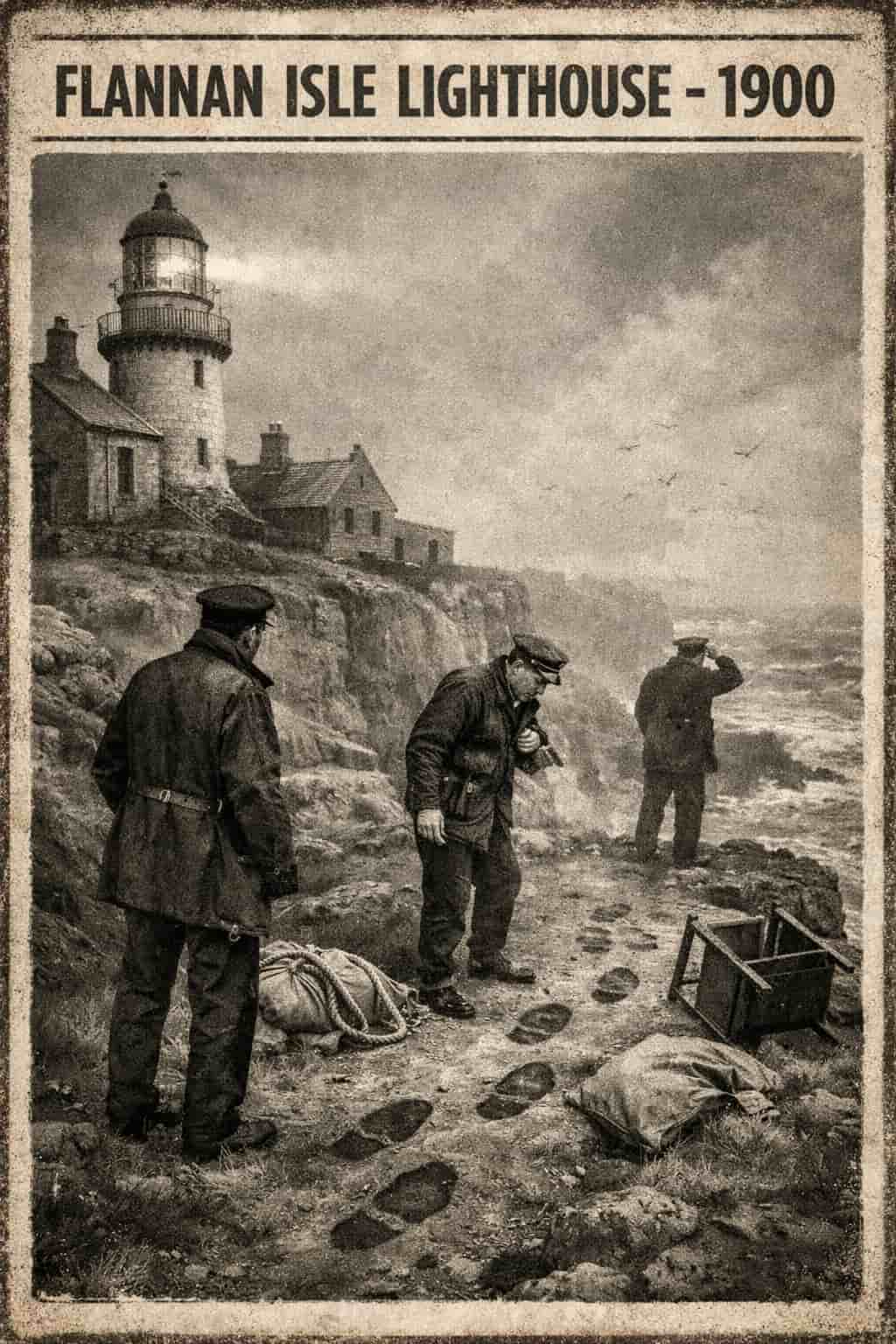
The door was unlatched. The lamps were cleaned and ready inside, as if the keepers had anticipated lighting them that evening. The last entry in the lighthouse log was dated December 15, the same day the passing steamship had reported the light was out.
Two of the three pairs of oilskin coats – the heavy waterproof clothing lighthouse keepers wore in bad weather – were missing from the hooks. There was one set remaining.
The clock on the wall had stopped running.
A chair by the kitchen table had been overturned and not set upright again.
That was all. That was all the relief crew found, a stopped clock, an overturned chair, two missing coats and three men who would simply disappeared.
The Logbook Entries
The lighthouse log entries from the days leading up to the disappearance added another layer of mystery — and controversy.
Accounts that followed the discovery said the log contained entries detailing vicious storms and the deteriorating mental state of the keepers. One entry supposedly described the men at prayer, another spoke of a keeper in tears, and a third claimed the storm to be the worst any of them had ever seen.
There was only one problem.
Weather records from the mainland in the vicinity of Dec. 15 failed to indicate a severe storm. It was recorded officially that the seas had been relatively calm.
Either the log entries were fabricated or exaggerated in hindsight – perhaps to make a more dramatic story – or something happened on Flannan Isle that the mainland weather stations just did not record.
To this day, historians can’t agree on which explanation is the correct one.
Theories .
In the more than one hundred and twenty years since the three keepers disappeared, many theories have been put forward as to what happened on Flannan Isle Lighthouse 1900.
The most popular theory is a tragic accident on the sea.
The western cliffs of the island, where the lighthouse had been built, had a lower platform used for storing equipment. There was evidence that the iron railings on this platform had been damaged, bent and twisted, as if by a giant wave. The platform had stored supplies that were washed away.
The theory is that two of the keepers, the ones missing their oilskin coats, went down to the platform to check the equipment or secure supplies and were hit by an unexpected, giant wave and swept out to sea.
The third keeper’s coat still hung on its hook; he may have seen what happened and, without waiting to put on his coat, rushed out and was swept away too.
That could be one explanation. It agrees with most of the physical evidence.
And it would explain the lack of bodies – the seas surrounding Flannan Isle Lighthouse 1900 are deep and violent, and a person washed from those cliffs would have little chance of survival, and even less of washing up in any recoverable state.
But that doesn’t explain all.
The stopped clock and the overturned chair are not explained; they are small details that point to something happening inside the lighthouse, not just outside. It does not fully account for the log entries, if those were genuine. And it doesn’t explain why, if the keepers went outside in dangerous conditions, they weren’t following proper safety protocols.
Experienced keepers did not take unnecessary chances. They knew the island. They knew the ocean. The idea that all three of them had been taken by surprise by one wave – all at once, with no one able to sound the alarm or leave any obvious sign of what had happened – seems to some investigators to be highly unlikely.
Other theories have been as dramatic as they have been outlandish. Some have suggested foul play, that one keeper killed the others and then either went missing or killed himself. Others have suggested that the men saw something on the island, or in the sea, that caused them to flee in panic.
Some supernatural explanations, dressed up into folklore over the years, are provided by a few accounts that the island’s local legends had always suggested.
None of these theories has ever been proved.
The Everlasting Mystery
The mystery of the Flannan Isle Lighthouse 1900 has fascinated for over a century, spawning poems, novels, films and countless retellings that have kept the story alive long after the men themselves had been lost to official records.
It’s the specific combination of elements – the isolated island, the experienced keepers, the clues that almost, but never quite, explain what happened – that refuses to let the story go.
Three men walked into a Scottish winter in 1900—and vanished completely.
Today, the lighthouse still stands on Flannan Isle Lighthouse 1900 , now automated, its light fueled by machines, not by human hands. No keepers have lived on the island since the early twentieth century.
The sea took James Ducat, Thomas Marshall and Donald McArthur; and the sea that took them has kept its secret for one hundred and twenty years.
It shows no sign of giving it up.
Flannan Isle Lighthouse 1900 · Outer Hebrides, Scotland · December, 1900
Three lightkeepers: James Ducat, Thomas Marshall, Donald McArthur
The light was reported unlit on December 15, 1900; the disappearance was discovered on December 26. · Bodies never recovered
Reason for disappearance: Unknown · Mystery not solved.
If you want to read more like this, click here: United Airlines Heist-1969-Never solved.
Sources & References
- National Records of Scotland — The Flannan Islands Lighthouse: A disappearance: https://www.nrscotland.gov.uk/learning-and-events/for-the-safety-of-all-scotlands-lighthouses/the-flannan-islands-lighthouse-a-disappearance/
TaleHive separates published reporting from personal accounts and editorial context where relevant.
More from the hive
Villisca Axe Murders – 1912
The Thing That Fell From the Sky Roswell New Mexico