The Bermuda Triangle — Legend, Flight 19 and What the Evidence Shows
A source-based TaleHive feature on The Bermuda Triangle — Legend, Flight 19 and What the Evidence Shows, separating documented history from theories,…
How do you want this story?
The Bermuda Triangle — Legend, Flight 19 and What the Evidence Shows
A source-based TaleHive feature on The Bermuda Triangle — Legend, Flight 19 and What the Evidence Shows, separating documented history from theories,… The Bermuda Triangle — Legend, Flight 19 and What the Evidence Shows The Bermuda Triangle is one of the world’s most famous modern mysteries, but official U.S. sources do not support the claim that ships and aircraft disappear there at an unusually high rate. A triangle created by stories The name “Bermuda Triangle” describes a loosely defined area of the western North Atlantic often drawn between Florida, Bermuda and Puerto Rico. The boundaries are not official and vary from author to author. Stories about unexplained disappearances in the region became especially popular in…
The Bermuda Triangle — Legend, Flight 19 and What the Evidence Shows
The Bermuda Triangle is one of the world’s most famous modern mysteries, but official U.S. sources do not support the claim that ships and aircraft disappear there at an unusually high rate.
A triangle created by stories
The name “Bermuda Triangle” describes a loosely defined area of the western North Atlantic often drawn between Florida, Bermuda and Puerto Rico. The boundaries are not official and vary from author to author. Stories about unexplained disappearances in the region became especially popular in the mid-twentieth century.
Books and magazines grouped unrelated maritime and aviation losses together and sometimes removed weather, navigation errors or later evidence from the retelling. The result was a powerful legend: a patch of ocean supposedly responsible for an extraordinary number of vanishings.
Flight 19
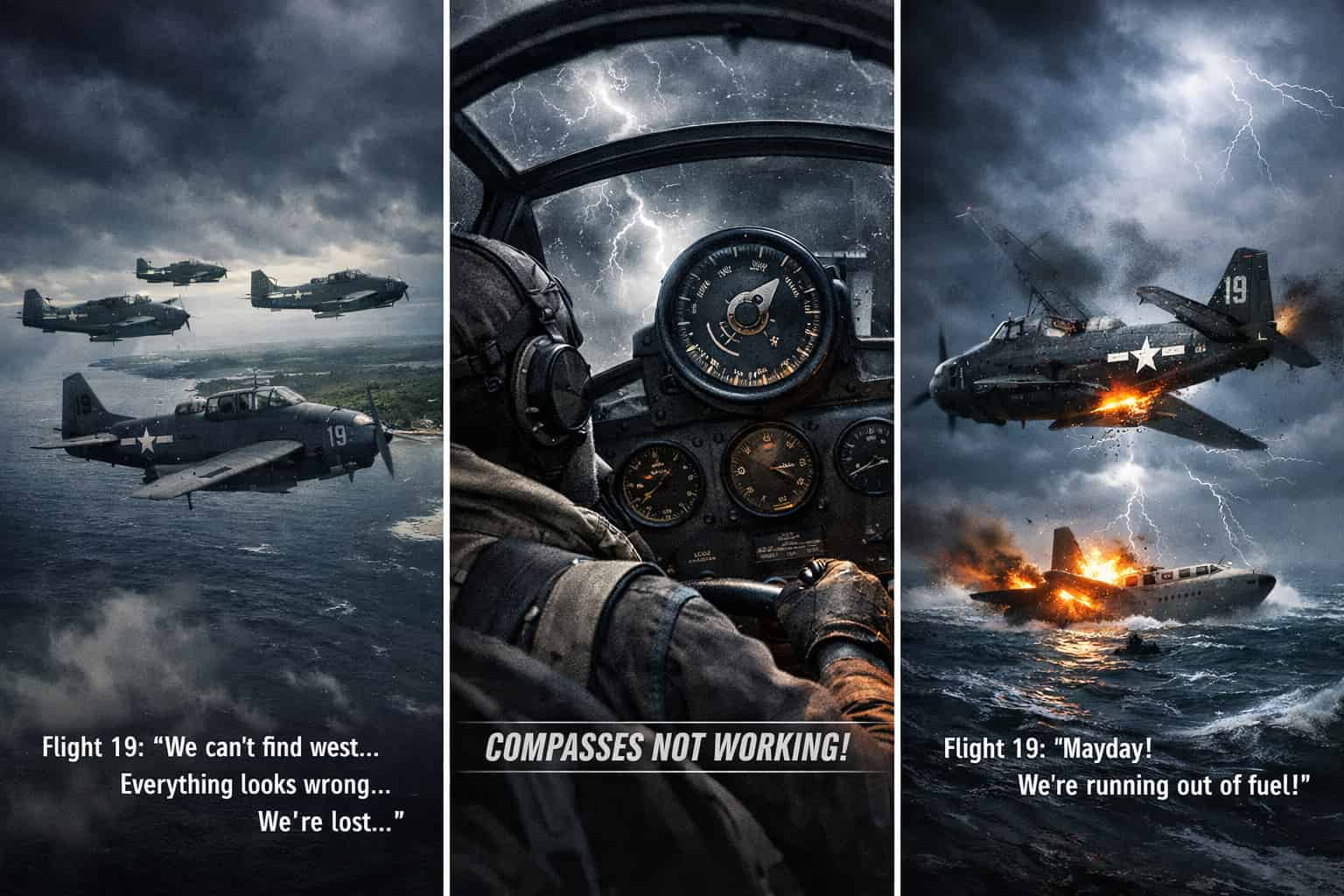
The most famous real event associated with the legend occurred on December 5, 1945. Five U.S. Navy TBM Avenger aircraft, known as Flight 19, departed Naval Air Station Fort Lauderdale on a routine training mission. Radio communications later indicated that the flight had become disoriented and was experiencing navigation problems.
The five aircraft and the 14 men aboard were never recovered. A PBM Mariner sent to search for them was also lost with 13 men aboard; historical Navy analysis notes evidence consistent with a catastrophic in-flight fire for the Mariner. The exact fate of the Avengers remains unknown.
What official history says
The U.S. Naval History and Heritage Command describes Flight 19 as a genuine aviation mystery but also notes that the event became heavily embellished as it was absorbed into Bermuda Triangle lore. Other Navy historical material states that the broader idea of an unusually dangerous supernatural triangle has been thoroughly debunked.
The region is heavily traveled by ships and aircraft and is exposed to tropical storms, hurricanes, strong currents and rapidly changing weather. Human navigation error, mechanical failure and ordinary maritime hazards provide explanations for many incidents later described as mysterious.
Mystery without exaggeration
Rejecting supernatural claims does not make every individual disappearance solved. Flight 19 remains unresolved because no confirmed wreckage has been found. The USS Cyclops, lost in 1918 with hundreds aboard, is another major naval loss in the same broad region whose precise cause remains unknown.
The responsible distinction is between an unsolved event and an unsupported pattern. There are real mysteries in the Atlantic. That is different from evidence that a special geometric zone causes ships and aircraft to vanish.
Why the story still matters
The Bermuda Triangle survives because it is an excellent story: open ocean, missing aircraft, imperfect records and no single boundary. TaleHive keeps the mystery while separating the folklore from what official records can actually establish.
Why Flight 19 became central to the legend
Flight 19 combined several ingredients that make mysteries durable: multiple aircraft, military personnel, worsening weather, confused radio messages and no confirmed wreckage. The disappearance occurred only months after the end of World War II, when large numbers of aircraft were operating and training from Florida. Because five bombers vanished together, the event felt larger than an ordinary single-aircraft accident.
The search added another layer. A PBM Mariner aircraft sent out to look for the missing formation also disappeared. Contemporary evidence supports a likely in-flight explosion for the Mariner, a type known to have fuel-vapor risks, but the coincidence of a search aircraft vanishing on the same evening fed later supernatural retellings. Separate incidents gradually became pieces of one dramatic narrative.
Official naval history focuses on navigation, weather, fuel and the uncertainty visible in the radio record. It does not present a paranormal cause. Even so, the absence of confirmed wreckage means historians cannot point to one recovered aircraft and demonstrate exactly what happened minute by minute. That gap between a plausible explanation and absolute physical confirmation is where legend thrives.
The Bermuda Triangle became popular culture because later writers grouped unrelated accidents within a loosely defined region and emphasized the strangest details. A careful reader should ask two questions separately: “Is this individual incident fully explained?” and “Is there evidence that this region causes an unusual number of disappearances?” An unresolved answer to the first question does not automatically prove the second.
What counts as evidence at sea
Maritime and aviation history often ends with uncertainty because wreckage can be difficult or impossible to recover. That makes primary records especially important: weather reports, fuel calculations, radio traffic, search logs and known aircraft limitations carry more weight than a later story that simply labels an event “mysterious.” A responsible mystery article can admit that evidence is incomplete without filling the gap with a supernatural claim.
This is the standard TaleHive uses on the Bermuda Triangle. Flight 19 is worth reading about because people disappeared and the final sequence is not perfectly reconstructed. The broader “Triangle” legend is a separate claim, and official naval histories do not support the idea of a special paranormal hazard. Keeping those two questions separate lets the real mystery remain compelling without exaggerating what the evidence shows.
Sources & References
- U.S. Naval History and Heritage Command — The Loss of Flight 19: https://www.history.navy.mil/browse-by-topic/disasters-and-phenomena/flight-19.html
- U.S. Naval History and Heritage Command — Bermuda Triangle bibliography and official-source links: https://www.history.navy.mil/research/library/bibliographies-and-research-guides/bibliographies/naval-adventures-and-misadventures/nautical-mysteries/bermuda-triangle.html
- U.S. Naval History and Heritage Command — The Loss of Flight 19 ↗
- U.S. Naval History and Heritage Command — Bermuda Triangle bibliography and official-source links ↗
TaleHive separates published reporting from personal accounts and editorial context where relevant.
More from the hive
Villisca Axe Murders – 1912