
Richard McCoy and the 1972 United Airlines Skyjacking
A non-graphic, source-based look at Richard McCoy and the 1972 United Airlines Skyjacking, separating documented facts from allegations, uncertainty and…
How do you want this story?
Richard McCoy and the 1972 United Airlines Skyjacking
A non-graphic, source-based look at Richard McCoy and the 1972 United Airlines Skyjacking, separating documented facts from allegations, uncertainty and… Richard McCoy and the 1972 United Airlines Skyjacking The real United Airlines parachute hijacking was not an unsolved 1969 cash heist. In 1972, Richard Floyd McCoy Jr. demanded $500,000, jumped from a Boeing 727 and was identified by the FBI within days. United Airlines Flight 855 On April 7, 1972, United Airlines Flight 855 departed Denver during a trip from Newark to Los Angeles. According to the FBI’s case history, a passenger displayed a hand grenade and a pistol and passed detailed hijacking instructions to the crew. He demanded $500,000 in cash and four parachutes.…
Richard McCoy and the 1972 United Airlines Skyjacking
The real United Airlines parachute hijacking was not an unsolved 1969 cash heist. In 1972, Richard Floyd McCoy Jr. demanded $500,000, jumped from a Boeing 727 and was identified by the FBI within days.
United Airlines Flight 855
On April 7, 1972, United Airlines Flight 855 departed Denver during a trip from Newark to Los Angeles. According to the FBI’s case history, a passenger displayed a hand grenade and a pistol and passed detailed hijacking instructions to the crew. He demanded $500,000 in cash and four parachutes.
For safety, the airline complied. The aircraft landed in San Francisco, where passengers were released after the ransom and parachutes were delivered. The hijacker then ordered the remaining crew to take the aircraft east on a specified route and at a specified speed and altitude.
A jump into the Utah night
After the plane crossed into Utah, the hijacker changed clothes, put on a parachute and jumped from the Boeing 727 with the ransom. The crew later landed safely. The method immediately drew comparisons with the still-unidentified D.B. Cooper hijacking from the previous November, but this case would develop very differently.
Investigators searched the aircraft and the area where the hijacker was believed to have landed. A citizen contacted the FBI and reported that an acquaintance, Richard Floyd McCoy Jr., had previously discussed a “foolproof” plan for hijacking an airplane. McCoy was a Vietnam veteran, helicopter pilot and experienced skydiver.
Evidence closes in
FBI examiners compared handwriting from a note left on the aircraft with samples from McCoy’s military records. Investigators also matched a latent fingerprint from an airline magazine near the hijacker’s seat to McCoy. Witness information placed him in the area after the jump.
Agents arrested McCoy on April 9, 1972. A search of his home recovered skydiving equipment, a typewriter linked to the instructions and $499,970 in cash. He was indicted, tried and convicted of aircraft piracy and related charges. A federal court sentenced him to 45 years in prison.
Why the correction matters
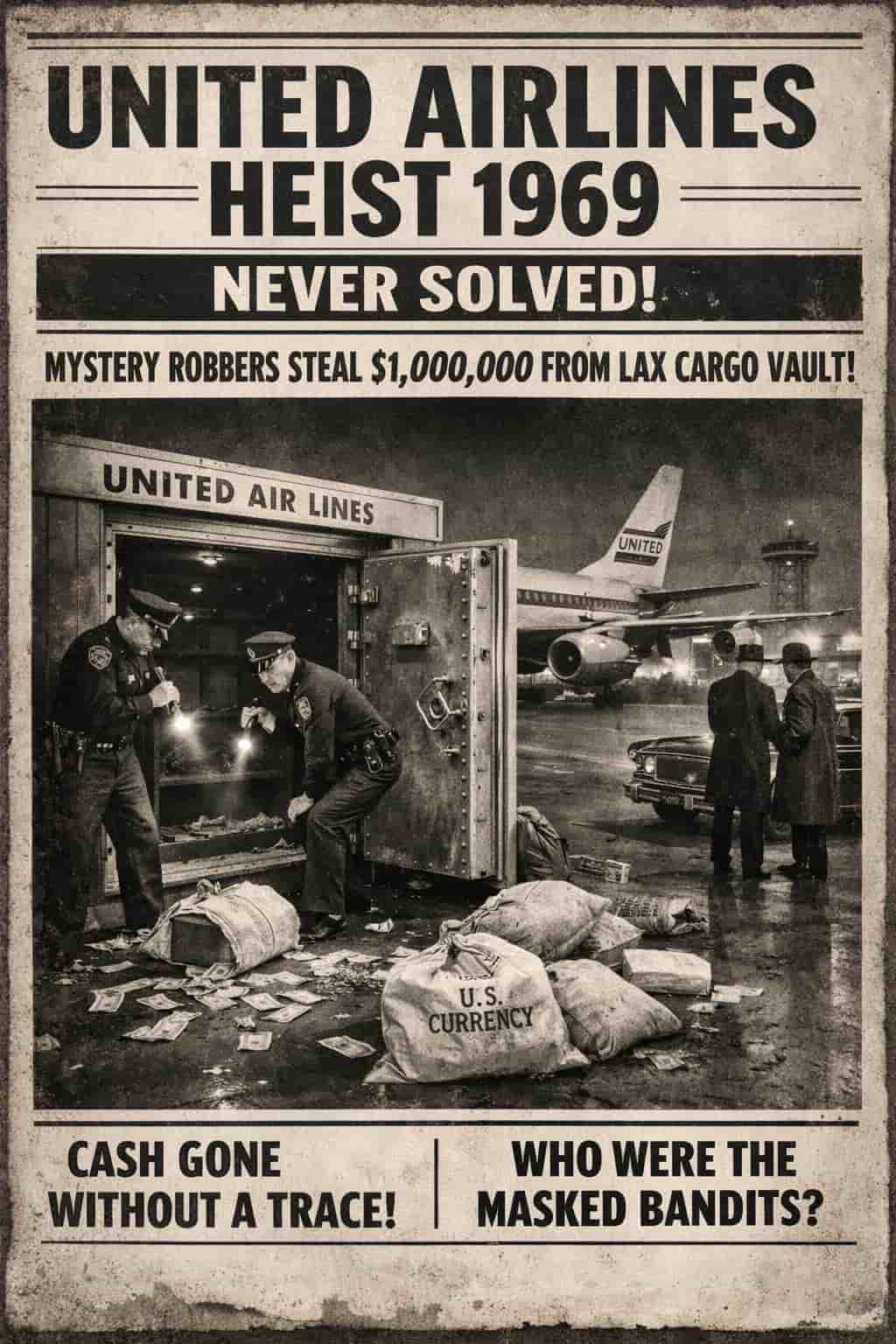
TaleHive previously carried this page as an “unsolved 1969 United Airlines heist.” Our review found no reliable basis for that version. The documented FBI case is the 1972 Flight 855 hijacking by Richard McCoy, and it was solved.
That distinction is exactly why source review matters in historical crime writing. A dramatic story can spread for years if dates, airlines and details are repeated without checking primary records. The FBI’s case file provides a clear timeline and identifies the perpetrator.
Why the story still matters
McCoy’s crime remains historically interesting because it occurred during the wave of U.S. skyjackings around the D.B. Cooper era. Unlike Cooper, however, McCoy was identified, arrested, convicted and imprisoned.
How investigators identified McCoy
The FBI account is unusually detailed about the evidence. After Flight 855 landed, agents collected material from the cabin and interviewed passengers and crew. One hand-printed note was left behind. A citizen then contacted the FBI and said an acquaintance, Richard Floyd McCoy Jr., had described a plan for hijacking an aircraft. McCoy was a Vietnam veteran, helicopter pilot, experienced skydiver and Utah Air National Guard member—skills relevant to the way the hijacker escaped.
Laboratory comparison linked the handwriting on the note to McCoy’s military records. Investigators also found a latent fingerprint on a United Airlines passenger magazine that matched McCoy. Witnesses placed him in the area after the jump. On April 9, 1972, a federal complaint was filed, and agents arrested him at his Provo home. A search uncovered skydiving equipment, a typewriter associated with the typed instructions and $499,970 in cash.
McCoy was indicted on April 14 and convicted after a federal trial. The FBI says he was found to have acted alone and was sentenced to 45 years. Those facts are why the old TaleHive headline describing a mysterious “1969 United Airlines Heist” was misleading. This case was not an unsolved theft with an unknown culprit; it was a documented 1972 aircraft piracy case with a named defendant, physical evidence, a trial and a conviction.
The episode is sometimes discussed because it occurred only months after the still-unidentified D.B. Cooper hijacker parachuted from another Boeing 727. Similarities have fueled speculation over the years, but similarity is not proof that the two men were the same person. TaleHive keeps the cases separate unless evidence establishes a connection.
Why correcting the record matters
Online articles can preserve an error for years because a dramatic headline is copied more often than the underlying record is checked. In this case, changing “1969” to 1972 and replacing “never solved” with the documented McCoy investigation materially changes what a reader learns. The FBI record gives a date, flight number, ransom demand, physical evidence, arrest, trial and conviction.
That correction also improves the surrounding mystery coverage on TaleHive. The D.B. Cooper case can remain an unresolved skyjacking story precisely because the McCoy case is presented separately and accurately. Combining similar crimes into one legend may create a stronger hook, but it weakens the history. Good mystery writing depends on knowing which questions are genuinely open.
Sources & References
- FBI — Richard Floyd McCoy Jr.: https://www.fbi.gov/history/cases-and-criminals/richard-floyd-mccoy-jr
TaleHive separates published reporting from personal accounts and editorial context where relevant.
More from the hive
Gilgo Beach Serial Killings — The Case That Changed in 2026
Golden State Killer California Caught after 40 years
 🎧 Audio Available