
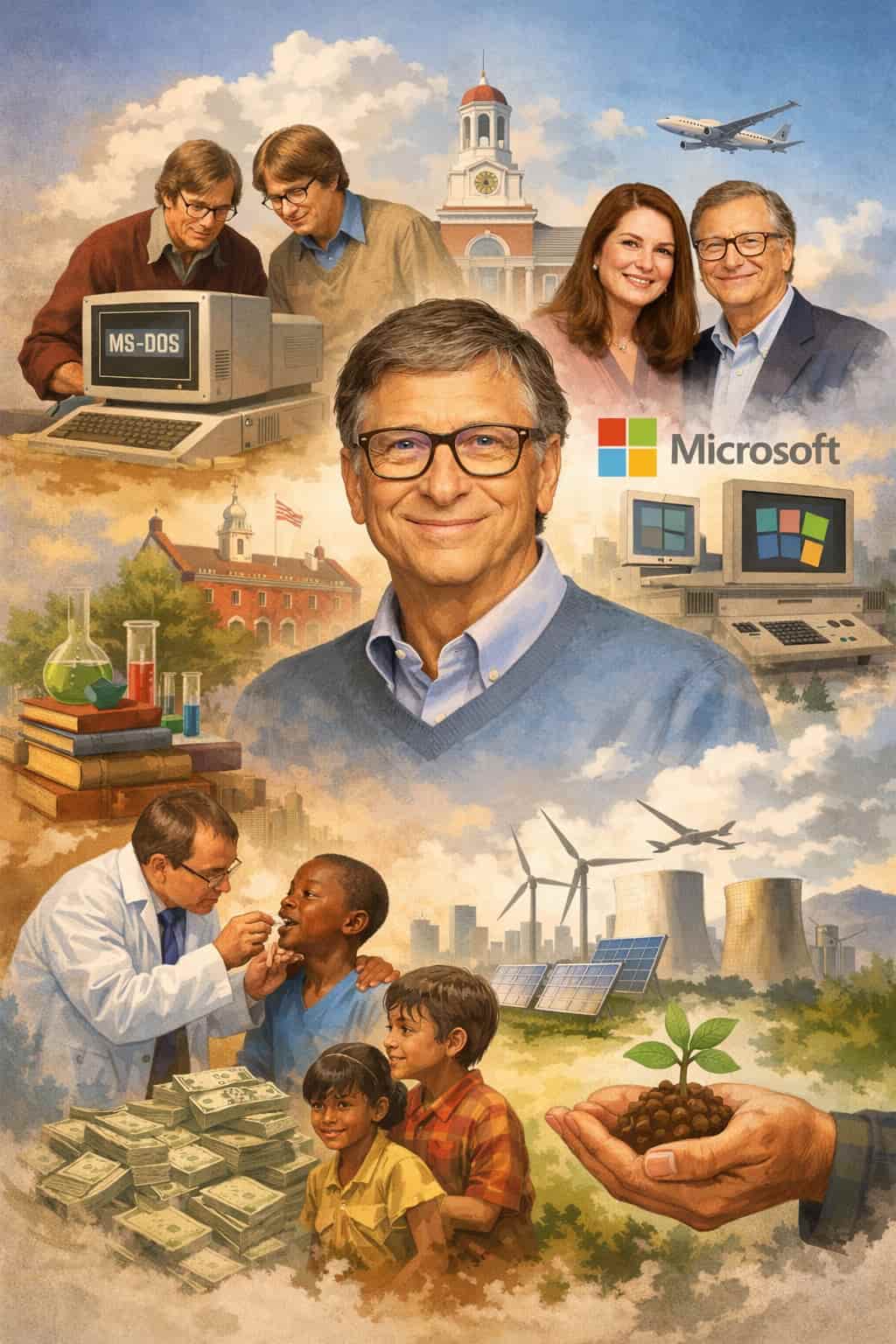
Bill Gates — From Microsoft to Global Philanthropy
Explore the documented turning points, decisions and setbacks behind Bill Gates — From Microsoft to Global Philanthropy, with sources and an editorially…
How do you want this story?
Bill Gates — From Microsoft to Global Philanthropy
Explore the documented turning points, decisions and setbacks behind Bill Gates — From Microsoft to Global Philanthropy, with sources and an editorially… Bill Gates — From Microsoft to Global Philanthropy How Bill Gates and Paul Allen built Microsoft around software for the emerging personal-computer market, and how Gates later shifted much of his time toward philanthropy. A software opportunity appears Bill Gates was born in Seattle in 1955 and became interested in computers as a student, when access to computing time was still unusual and expensive. He met Paul Allen at school, and the two shared an interest in programming and in the possibility that computing would move beyond large institutional machines. In 1975, after…
Bill Gates — From Microsoft to Global Philanthropy
How Bill Gates and Paul Allen built Microsoft around software for the emerging personal-computer market, and how Gates later shifted much of his time toward philanthropy.
A software opportunity appears
Bill Gates was born in Seattle in 1955 and became interested in computers as a student, when access to computing time was still unusual and expensive. He met Paul Allen at school, and the two shared an interest in programming and in the possibility that computing would move beyond large institutional machines.
In 1975, after seeing the Altair 8800 microcomputer, Gates and Allen developed software for the new machine and founded Microsoft. The timing was crucial. Personal computing was still an emerging industry, and hardware makers needed programming languages and operating software that would make their machines useful to a much larger audience.
Microsoft and the PC era
Microsoft built its business around software rather than manufacturing its own computers. A decisive moment came when IBM selected Microsoft to provide an operating system for its personal computer. Microsoft retained the ability to license related software more broadly, positioning the company to benefit as IBM-compatible PCs spread across the market.
MS-DOS and later Windows became central to the personal-computer ecosystem. Microsoft also developed applications such as Word and Excel and eventually the Office suite. The company’s scale came from being a software layer used across machines produced by many manufacturers.
Competition and antitrust scrutiny
Microsoft’s dominance brought legal and regulatory scrutiny. In the 1990s the U.S. government pursued a major antitrust case alleging that Microsoft used its operating-system power to protect and extend its position, particularly during the browser wars. The litigation became one of the defining technology-policy battles of the era.
That history matters because it complicates a simple founder-success narrative. Products can create enormous value while business practices are simultaneously challenged by competitors and regulators. Understanding Microsoft requires both the technical shift it helped drive and the market power that followed.
Changing roles
Gates served as Microsoft’s chief executive until 2000 and remained deeply involved in the company afterward, including as chairman and chief software architect for periods of time. As the company matured, leadership transitioned to other executives and Microsoft itself moved through major changes in internet services, enterprise software, cloud computing and artificial intelligence.
Gates gradually redirected more of his time toward the foundation he created with Melinda French Gates. The foundation has funded work in global health, development and education, among other areas. Its scale gives it substantial influence, which also makes transparency, evidence and public debate about philanthropic priorities important.
Two different kinds of institution
Microsoft and a philanthropic foundation operate under very different incentives. Microsoft earns revenue by selling technology and services in competitive markets. A foundation deploys donated wealth toward social goals selected through its governance. Gates’ biography connects the two because the fortune generated by software financed later philanthropy, but the work should not be treated as one uninterrupted business project.
The lasting technology lesson is that Gates and Allen recognized software as a business in its own right before that idea was obvious to everyone. The later civic lesson is that enormous private wealth can be redirected toward public problems while still raising legitimate questions about priorities, accountability and impact.
Why the story still matters
Bill Gates’ story is not defined by a current wealth estimate. It is a long arc from early software entrepreneurship to the institutional power of Microsoft and then to large-scale philanthropy, with important achievements and controversies in each stage.
Software standards and the power of distribution
Microsoft’s early advantage was not simply that Gates could write code. The company positioned its software to run across a growing ecosystem of personal computers. When an operating system becomes a common platform, developers have an incentive to build applications for it, customers have an incentive to buy compatible software, and computer manufacturers have an incentive to support what customers already use. Those reinforcing effects helped Windows become extraordinarily important.
The same platform power created tension. Competitors argued that Microsoft could use control of Windows to favor its own products, while Microsoft argued that integrating new capabilities was part of improving the operating system. The antitrust battles of the 1990s and early 2000s became a foundational example of how competition law applies to fast-moving digital platforms.
Gates’ later move toward philanthropy did not erase that business history, and philanthropy itself is not beyond criticism. Large foundations can fund research and programs at a scale governments or smaller charities may struggle to match, but they also concentrate agenda-setting power in private institutions. A mature profile can recognize both the resources Gates helped mobilize and the legitimate debate over how those resources are governed.
Why the story remains relevant
Microsoft eventually had to adapt beyond the PC-centered world that created its original dominance. The company’s later growth in cloud services, enterprise subscriptions and artificial intelligence demonstrates that even a powerful platform cannot assume its first market will define the future forever. Gates’ founding-era decisions matter because they established the software business, but Microsoft’s continued relevance also depends on leaders and engineers who worked after his day-to-day role diminished.
Sources & References
- Gates Foundation — Bill Gates / leadership and history: https://www.gatesfoundation.org/about/leadership/bill-gates
- Microsoft — company history: https://news.microsoft.com/facts-about-microsoft/
TaleHive separates published reporting from personal accounts and editorial context where relevant.
More from the hive
 🎧 Audio Available
Phil Knight — From Car Trunk to Nike

Jan Koum — From Food Stamps to WhatsApp