
Michael Dell — From Dorm Room to Dell Technologies
Explore the documented turning points, decisions and setbacks behind Michael Dell — From Dorm Room to Dell Technologies, with sources and an editorially…
How do you want this story?
Michael Dell — From Dorm Room to Dell Technologies
Explore the documented turning points, decisions and setbacks behind Michael Dell — From Dorm Room to Dell Technologies, with sources and an editorially… Michael Dell — From Dorm Room to Dell Technologies How a 19-year-old used a direct-to-customer computer model to challenge the way personal computers were sold. A fascination with how systems work Michael Dell grew up in Houston and was interested in both technology and business from an early age. He took apart computers to understand their components and experimented with small ventures before college. The pattern was consistent: learn how a system works, identify where money or time is being wasted, and try a more direct route. In 1983 he enrolled at…
Michael Dell — From Dorm Room to Dell Technologies
How a 19-year-old used a direct-to-customer computer model to challenge the way personal computers were sold.
A fascination with how systems work
Michael Dell grew up in Houston and was interested in both technology and business from an early age. He took apart computers to understand their components and experimented with small ventures before college. The pattern was consistent: learn how a system works, identify where money or time is being wasted, and try a more direct route.
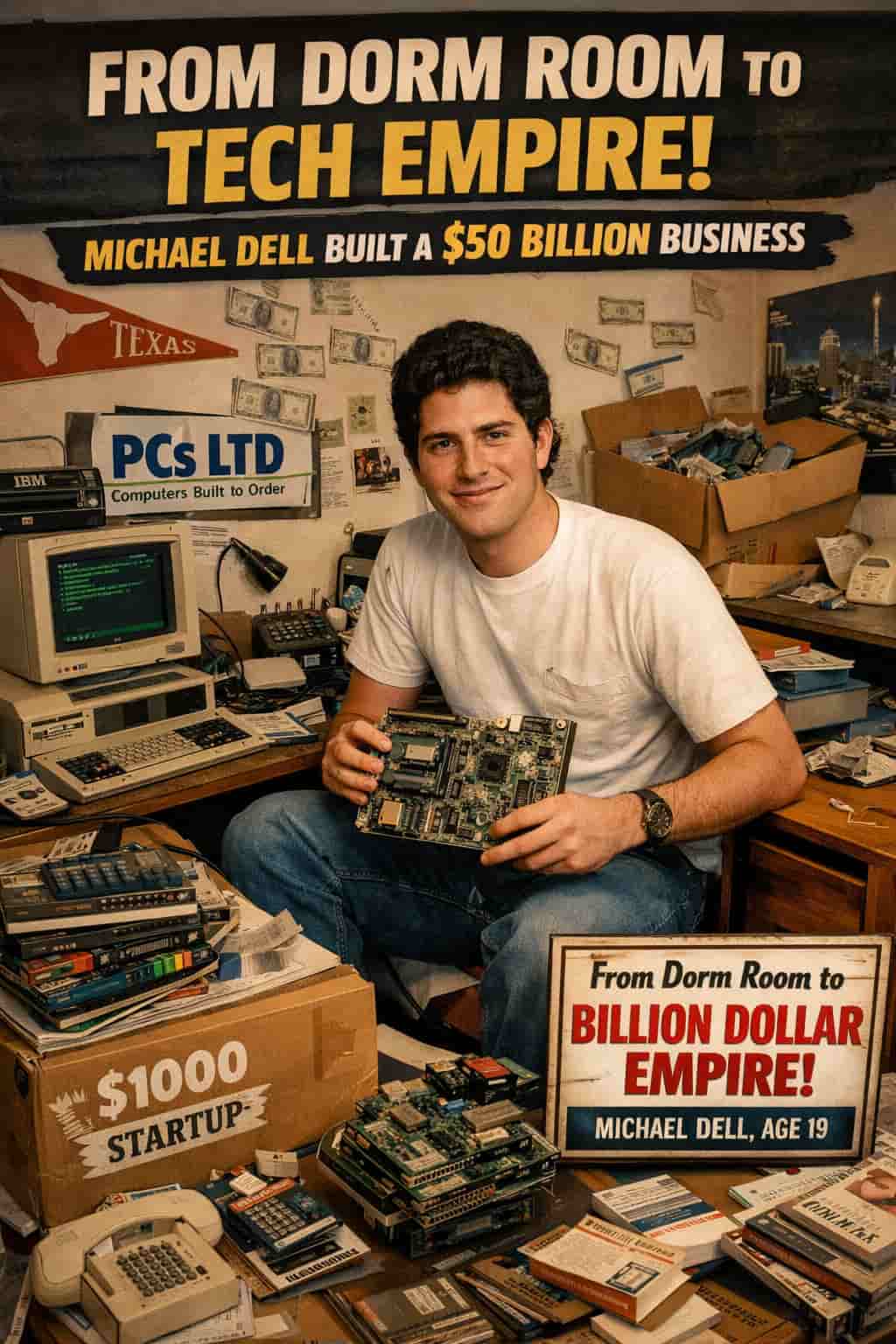
In 1983 he enrolled at the University of Texas at Austin. While studying, he upgraded and sold personal computers from his dorm room. Rather than treating a PC as a sealed retail product, he saw a collection of standardized components that could be configured around what a customer actually needed.
The direct model
In 1984, at age 19, Dell founded the business that would become Dell Technologies with $1,000. The key idea was direct selling. Customers could order a computer configured to their needs, and the company could build closer to demand instead of sending large inventories through layers of distributors and retail stores.
That approach helped reduce inventory risk and gave the company direct information about what customers were requesting. Dell advertised in computer publications, took orders by phone and built machines to specification. The model was not magic; it depended on operations, component sourcing, support and disciplined execution. But it gave a young company a way to compete with much larger firms.
Rapid growth and public markets
Dell grew quickly through the 1980s and entered the public markets in 1988. Michael Dell became one of the youngest leaders of a Fortune 500 company. As the personal-computer market expanded, the company became known for build-to-order manufacturing, relatively low inventory and direct customer relationships.
The same model eventually faced pressure as consumer technology changed and competition intensified. Dell stepped away from the CEO role in 2004 and returned in 2007 as the business tried to broaden beyond consumer PCs.
Rebuilding around enterprise technology
In 2013 Michael Dell and partners took the company private, allowing a long restructuring outside the quarter-to-quarter pressures of public markets. In 2016 Dell completed the combination with EMC in a transaction valued at about $67 billion, creating a much larger enterprise-technology business. Dell Technologies returned to public markets in 2018.
The company that began in a student room had become a global technology organization spanning PCs, servers, storage and enterprise infrastructure. Dell remains chairman and chief executive officer.
Why the story still matters
The important part of the story is not a mythic dorm-room moment. It is the business model: sell directly, listen to demand, keep inventory moving and redesign the company when the market changes.
The business model behind the dorm-room story
Dell’s early insight was not merely that computers were expensive. The important question was how they reached the buyer. Selling directly let the company receive orders from customers before assembling many machines, learn what configurations people actually wanted and avoid relying entirely on a traditional retail channel. That model became one of the defining ideas associated with Dell during the personal-computer boom.
The company’s official timeline records that Michael Dell founded PC’s Limited in 1984 with $1,000 while a freshman at the University of Texas and left school to focus on the business. Four years later the company raised $30 million in its initial public offering, giving it a market capitalization of $85 million. Those milestones show how quickly the business moved from a student venture into a public company, but the transition also required manufacturing, service, logistics and financing systems that a dorm-room seller did not initially possess.
Dell later faced a different problem: the PC market matured, competitors improved and enterprise technology became increasingly important. Michael Dell returned as chief executive in 2007, took the company private in 2013 and led the 2016 acquisition of EMC, a transaction that dramatically expanded Dell’s position in enterprise infrastructure. The modern Dell Technologies is therefore not simply the same PC company made larger; it reflects repeated changes in strategy as the technology market evolved.
The useful takeaway is operational. Dell saw a distribution inefficiency, built a company around it and then had to keep adapting after competitors learned from the model. An advantage can create a company, but it rarely protects that company forever. The harder task is recognizing when the original advantage is no longer enough.
Why the model still matters
Dell’s direct-sales approach became famous enough that competitors copied parts of it, which is exactly what happens to a visible business advantage. Once an idea is understood, the advantage shifts from the idea itself to execution: forecasting demand, sourcing components, supporting customers and improving the supply chain faster than rivals. The company had to keep doing those less glamorous jobs after the dorm-room origin story stopped being novel.
That is why Michael Dell’s career is better understood as a series of operating decisions than as a dropout fairy tale. Leaving college did not create the company; a functioning model, customer demand and years of execution did. The later move into enterprise infrastructure shows the same principle from another direction: when the market changes, a company has to decide which parts of its original identity are essential and which parts must evolve.
Sources & References
- Dell Technologies — Michael Dell biography: https://www.dell.com/en-uk/dt/corporate/about-us/leadership/michael-dell.htm
- Dell — World Changers: Michael Dell: https://i.dell.com/sites/content/corporate/speeches/en/Documents/WorldChangers_MichaelDell.pdf
TaleHive separates published reporting from personal accounts and editorial context where relevant.
More from the hive
 🎧 Audio Available
Phil Knight — From Car Trunk to Nike

Jan Koum — From Food Stamps to WhatsApp