
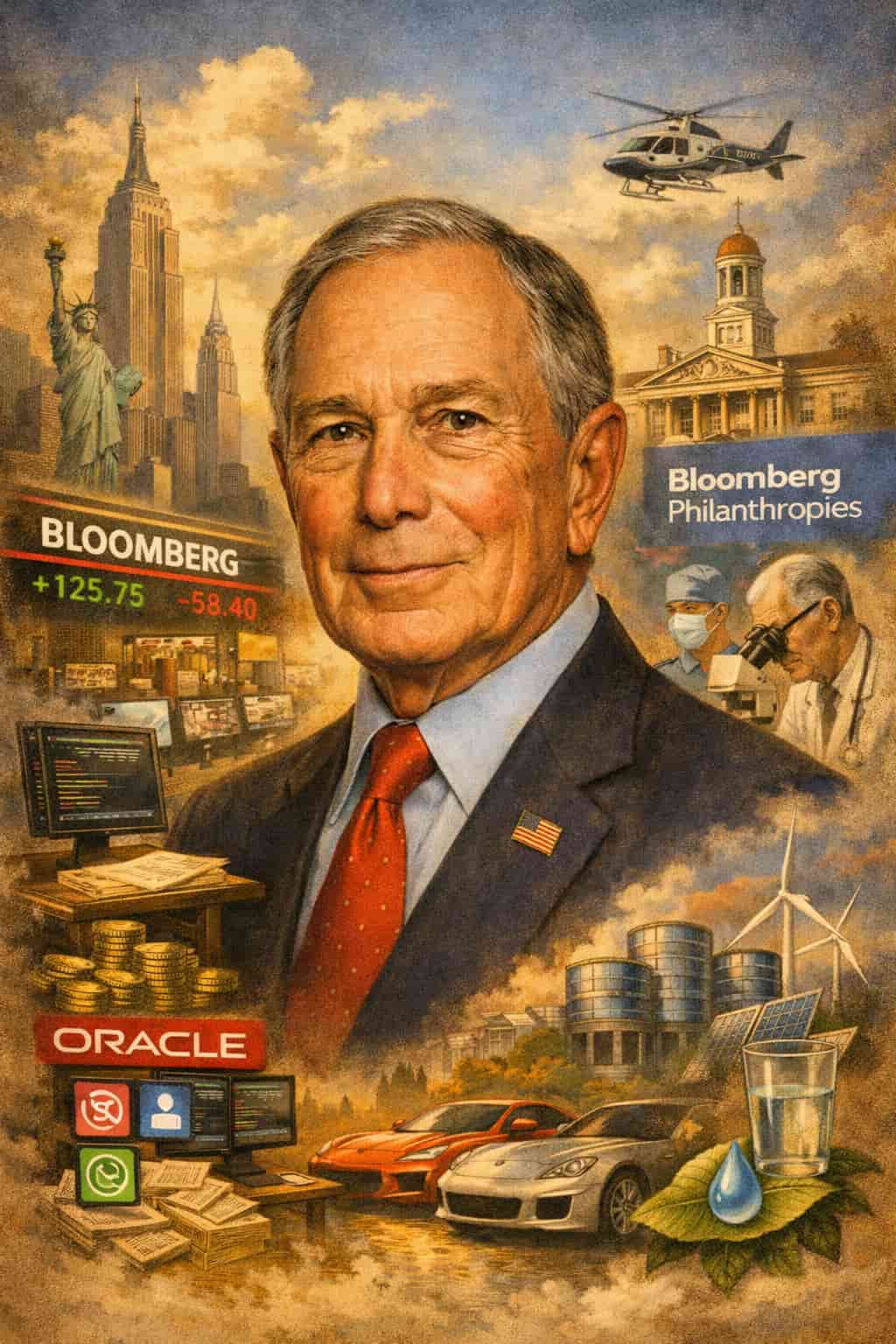
Michael Bloomberg — From Wall Street to Bloomberg and City Hall
Explore the documented turning points, decisions and setbacks behind Michael Bloomberg — From Wall Street to Bloomberg and City Hall, with sources and an…
How do you want this story?
Michael Bloomberg — From Wall Street to Bloomberg and City Hall
Explore the documented turning points, decisions and setbacks behind Michael Bloomberg — From Wall Street to Bloomberg and City Hall, with sources and an… Michael Bloomberg — From Wall Street to Bloomberg and City Hall How a Wall Street information problem became Bloomberg L.P., and how its founder later moved from business into three terms as mayor of New York City and large-scale philanthropy. Learning finance and information systems Michael Bloomberg was born in 1942 and raised in Massachusetts. He studied electrical engineering at Johns Hopkins University and later earned an MBA from Harvard Business School. In 1966 he joined Salomon Brothers, where his work eventually included both securities trading and information systems. That combination…
Michael Bloomberg — From Wall Street to Bloomberg and City Hall
How a Wall Street information problem became Bloomberg L.P., and how its founder later moved from business into three terms as mayor of New York City and large-scale philanthropy.
Learning finance and information systems
Michael Bloomberg was born in 1942 and raised in Massachusetts. He studied electrical engineering at Johns Hopkins University and later earned an MBA from Harvard Business School. In 1966 he joined Salomon Brothers, where his work eventually included both securities trading and information systems. That combination exposed him to a basic problem in finance: professionals needed faster, more organized access to market data.
When Salomon was acquired in 1981, Bloomberg left the firm. Instead of moving directly to another Wall Street employer, he used the opportunity to build a new business around financial information. The idea was that technology could give investors and traders data, analytics and communication tools in a more useful form than the fragmented systems of the time.
Building Bloomberg L.P.
Bloomberg founded the company that became Bloomberg L.P. in 1981. Its defining product evolved into the Bloomberg Terminal, a professional system combining market data, analytics, news and communication. The value was not a single screen of prices; it was the ability to place many tools used by financial professionals into one integrated service.
The company expanded from data terminals into news, media and other financial-information services. Its business model became strongly associated with subscriptions from institutions and professionals rather than mass-market consumer advertising. That recurring relationship with customers helped make Bloomberg a durable private company in a field where accuracy, speed and reliability are central to the product.
From business to public office
Bloomberg entered politics late compared with career politicians. He was elected mayor of New York City in 2001 and took office shortly after the September 11 attacks, when the city was dealing with economic disruption as well as the human consequences of the attacks. He was reelected twice and served three terms, leaving office at the end of 2013.
His mayoralty included policies on public health, education, development, transportation, policing and environmental planning. Many were praised by supporters and criticized by opponents. A neutral account should not compress twelve years of city government into a simple success story. The important point for this profile is that Bloomberg moved from building a private information company into managing a complex public institution where decisions were subject to elections, courts, legislatures, public scrutiny and competing interests.
Philanthropy and public initiatives
After leaving City Hall, Bloomberg continued to fund initiatives through Bloomberg Philanthropies, with work in areas including public health, cities, climate, education and the arts. Philanthropy gave him another channel for pursuing policy goals, but it is structurally different from elected government: private donors can choose priorities in ways public officials cannot.
Bloomberg has also remained closely associated with the company that carries his name. Because Bloomberg L.P. is private, the story is less about a continuously changing personal net-worth estimate and more about the information infrastructure the business created for global finance.
The useful business lesson
The origin of Bloomberg L.P. illustrates a recurring entrepreneurial pattern: industry experience reveals a costly information problem, and a company is built to solve it. Bloomberg understood both the workflows of financial professionals and the possibilities of computing. That combination mattered more than simply having access to technology.
The company also demonstrates the power of a professional tool that becomes embedded in daily work. Once data, analytics, messaging and institutional habits are built around a platform, switching is not a casual decision. That kind of usefulness can create a stronger business than a product that attracts attention but does not become essential to a customer’s job.
Why the story still matters
Michael Bloomberg’s career crosses business, government and philanthropy. Each arena has different measures of success and different forms of accountability, so this profile treats them separately rather than presenting wealth as proof that every later decision was correct.
Information as infrastructure
The Bloomberg Terminal became powerful because financial information is time-sensitive and decisions are interconnected. A trader might need a price, a company filing, historical data, a calculation, a message from a colleague and a news update within minutes. Putting those functions into one professional environment reduced the friction of moving between disconnected sources.
That kind of product creates a different competitive position from a consumer website. Users learn commands, firms build workflows around the service and teams communicate through it. The value comes not only from the data but from the habits and institutional processes surrounding the data. That helps explain why the business could remain important even as the wider internet made raw information easier to find.
Bloomberg’s later public career also demonstrates that skill in one institution does not transfer automatically into universal authority. Running a private company allows concentrated decision-making; governing a city requires compromise, public law and democratic accountability. Treating those roles separately gives readers a more accurate picture of both the achievements and the limits of a business-success narrative.
Sources & References
- Bloomberg Philanthropies — Founder Michael R. Bloomberg: https://www.bloomberg.org/founder/
- City of New York Archives — Mayoral records and history: https://www.archives.nyc/
- Bloomberg Philanthropies — Founder Michael R. Bloomberg ↗
- City of New York Archives — Mayoral records and history ↗
TaleHive separates published reporting from personal accounts and editorial context where relevant.
More from the hive
 🎧 Audio Available
Phil Knight — From Car Trunk to Nike

Jan Koum — From Food Stamps to WhatsApp