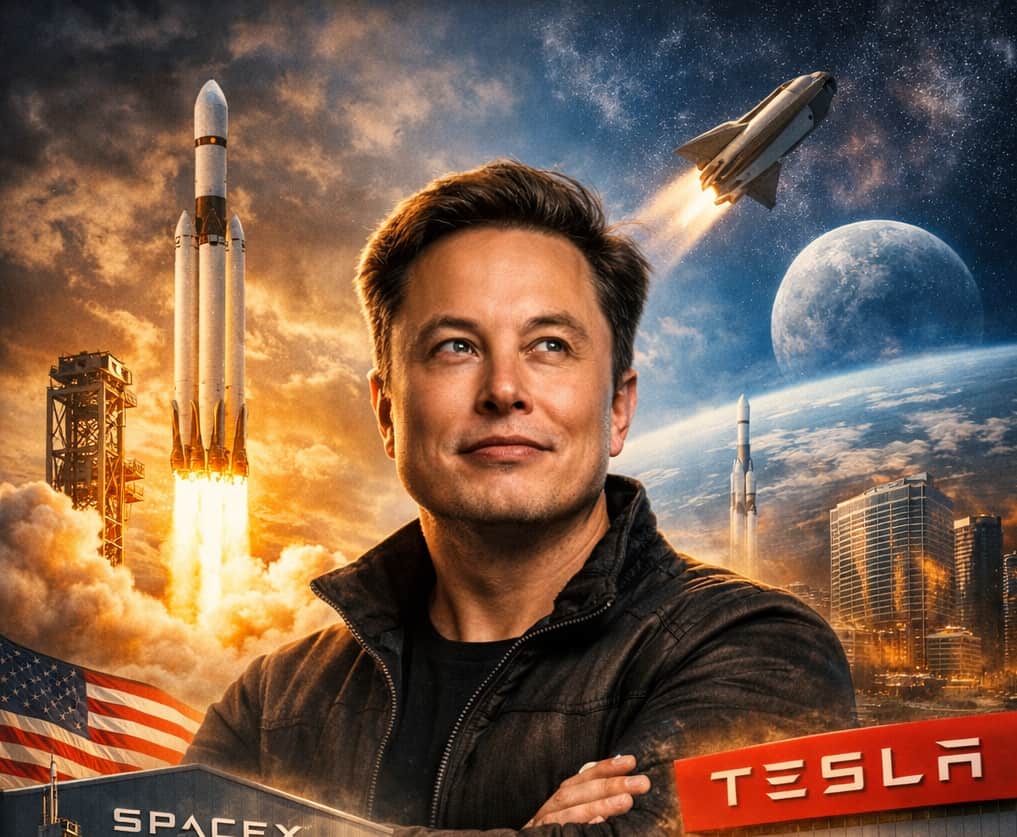
Elon Musk — From Zip2 to SpaceX and Tesla
Explore the documented turning points, decisions and setbacks behind Elon Musk — From Zip2 to SpaceX and Tesla, with sources and an editorially reviewed…
How do you want this story?
Elon Musk — From Zip2 to SpaceX and Tesla
Explore the documented turning points, decisions and setbacks behind Elon Musk — From Zip2 to SpaceX and Tesla, with sources and an editorially reviewed… Elon Musk — From Zip2 to SpaceX and Tesla An evidence-based overview of Elon Musk’s path from internet startups to leadership roles in electric vehicles, launch services and other technology ventures. Early software companies Elon Musk was born in Pretoria, South Africa, in 1971 and later moved to North America. He studied at the University of Pennsylvania. His early business career was in software: he co-founded Zip2, which provided internet-based business and mapping services, and the company was acquired by Compaq in 1999. Musk then helped build an online financial-services company…
Elon Musk — From Zip2 to SpaceX and Tesla
An evidence-based overview of Elon Musk’s path from internet startups to leadership roles in electric vehicles, launch services and other technology ventures.
Early software companies
Elon Musk was born in Pretoria, South Africa, in 1971 and later moved to North America. He studied at the University of Pennsylvania. His early business career was in software: he co-founded Zip2, which provided internet-based business and mapping services, and the company was acquired by Compaq in 1999.
Musk then helped build an online financial-services company that became part of PayPal. eBay acquired PayPal in 2002. Those transactions gave Musk capital and experience at a moment when internet businesses were moving from experimentation into mainstream commerce.
SpaceX and the cost of reaching orbit
Musk founded SpaceX in 2002. The company’s long-term ambition included reducing the cost of space transportation. Early launches failed before the Falcon 1 reached orbit successfully in 2008. SpaceX later developed the Falcon 9 and Dragon spacecraft and became a major provider of commercial and government launch services.
Reusable rocket stages became one of the company’s most visible engineering achievements. Landing and re-flying boosters does not eliminate the cost of spaceflight, but it changes the economics of hardware that historically was discarded after a launch. SpaceX also built the Starlink satellite network and continued developing the larger Starship system.
Tesla and electric vehicles
Tesla was founded by Martin Eberhard and Marc Tarpenning before Musk joined the company as an early investor and chairman. Musk became chief executive in 2008. Under his leadership Tesla moved from the Roadster toward higher-volume vehicles and invested heavily in batteries, manufacturing and charging infrastructure.
Tesla’s growth helped push electric vehicles from a niche product toward a central strategic priority for the global auto industry. At the same time, the company has faced recurring debates over production practices, driver-assistance marketing, governance, labor and Musk’s public statements. Those issues belong in a balanced account alongside the company’s engineering and market achievements.
A portfolio of ambitious ventures
Musk has also been associated with companies including Neuralink, focused on brain-computer interfaces; The Boring Company, focused on tunneling and transportation infrastructure; and xAI, focused on artificial intelligence. He acquired Twitter in 2022 and later renamed the platform X, adding another large and controversial company to his portfolio.
The breadth of these activities makes simple labels such as “inventor of Tesla” inaccurate. Musk is best understood as an entrepreneur, investor and executive who has repeatedly directed capital and attention toward technically difficult industries, often with aggressive schedules and unusually high tolerance for risk.
How to evaluate the record
Musk inspires both intense admiration and intense criticism. TaleHive does not treat either reaction as a substitute for evidence. The useful questions are concrete: What company did he found or join? What role did he hold? Which products reached customers? Which claims remain goals rather than completed achievements? What risks or controversies are documented?
That approach produces a more durable story than a daily wealth ranking or a list of dramatic promises. Zip2, PayPal, SpaceX and Tesla are important because they show how Musk repeatedly moved into industries where software, hardware, capital and physical engineering had to work together. The outcomes can be assessed without turning the executive into either a hero or a villain.
Why the story still matters
Elon Musk’s companies continue to change rapidly. This profile focuses on established milestones and separates current operations from future ambitions so the article can remain useful even as valuations, titles and product timelines move.
Ambition versus completed engineering
Musk is unusually willing to describe long-term goals in public, from fully autonomous vehicles to Mars settlement. Those statements can inspire teams and attract attention, but an editorial profile has to separate a goal, a prototype and a deployed product. SpaceX landing orbital-class boosters is a demonstrated capability; a self-sustaining city on Mars remains an ambition. Tesla sells vehicles with advanced driver-assistance features; those systems should not be described as fully autonomous merely because that is a long-term objective.
That distinction is especially important because Musk’s companies operate in safety-sensitive fields. Rockets, cars, medical interfaces and transportation systems are judged not only by novelty but by reliability, regulation and real-world performance. Engineering progress can be significant without every announced timeline being achieved.
The broader pattern in Musk’s career is a preference for capital-intensive problems that software entrepreneurs often avoid. Building factories, launch pads, satellites and vehicles demands physical supply chains and regulatory approval as well as code. That makes the results harder to produce—and makes careful verification more important when writing about what has actually been accomplished.
Why dates and titles matter
Because Musk holds or has held roles across several companies, profiles can easily blur who founded what and when. Tesla existed before he joined; SpaceX was founded by Musk; PayPal emerged from companies in which he was a co-founder and executive. Those distinctions do not reduce his influence. They make the record more precise and help readers separate leadership, investment, founding and engineering claims instead of treating them as interchangeable.
Sources & References
- Tesla Investor Relations — proxy statements and leadership: https://ir.tesla.com/
- SpaceX — Company: https://www.spacex.com/
TaleHive separates published reporting from personal accounts and editorial context where relevant.
More from the hive
 🎧 Audio Available
Phil Knight — From Car Trunk to Nike
Jan Koum — From Food Stamps to WhatsApp